There is an old adage in the aviation industry: if you want to make a million pounds, start with ten million, and run an airline. The aviation industry has lost quite staggering amounts of money since 2001, as a consequence of the threat of terrorism, SARS, high fuel prices and sundry other problems.
Actually, this isn't entirely true. It would be more precise to say that the aviation industry in North America has lost loads of money. Across the world as a whole, the industry has not fared too badly. But what this hides is the variety of financial performance.
In North America, the biggest four players in aviation - American, United, Northwest and Delta - are all in Chapter 11 bankruptcy protection, having probably lost more money between them than the rest of the industry has made. This means that they can continue to operate but being protected from their creditors. Which means in turn (in effect) that they can ignore their liabilities. In the meantime, airlines like Southwest are bucking the trend by making money and expanding.
In Europe, the days are finally passing when state airlines can be bailed out by their government. The major casualty in this regard so far is Sabena - the Belgian national airline - which made a profit in one year out of over 50. Swiss continues to try and repackage itself out of financial danger; other notably vulnerable airlines are Alitalia, Olympic (which has also never made a profit, I believe) - I understand that the status of payments made to these two airlines are currently being investigated for their legality - and Cyprus Airways. To get some idea of how bad the industry in Europe has been, Air France was given a "one-time" payment at one stage, I believe, that amounted to £5 for every person in the European Union.
However, in difficult times, although across Europe as a whole airlines are roughly breaking even, what is really happening is that there are a stack of airlines that are making significant losses whilst other airlines (British Airways, Ryanair, Easyjet) make healthy profits.
So the playing field is far from level. North American airlines are allowed to continue operating, preventing competition in key market places (one such being flights between the US and Heathrow, for example), whilst actually failing to make money but being protected from the consequences of this. European state airlines (though less so now) have inefficient practices but are still able to use their privileged position to stifle competition. It is hardly surprising that the success stories in the industry have carved out new markets for themselves, given the stranglehold that the legacy operators had over the existing ones. Of course it is important to have mechanisms to protect jobs - union agreements, bankruptcy laws and so on - but these laws weren't ever meant to prevent efficient companies competing with companies that were unable to be competitive.
Caught in the middle are independent airlines - unable to get fair access to the markets that they know they can make money on. The list of airlines that have failed in the last four decades is long. For the most part, it wasn't due to any particular flaw in their business model, except for the fact that they assumed that there might be a level playing field.
Monday, September 19, 2005
Friday, September 16, 2005
Cheap cigarettes
I never understood why people would want to buy friends and relations cheap, duty-free cigarettes. "I don't smoke, but Auntie Flo does, so I could get 200 B+H for her. It's only fifteen quid."
They must really dislike them.
"I know you have tendencies to self harm. I bought you a cheap gun; why don't you go and kill yourself?"
They must really dislike them.
"I know you have tendencies to self harm. I bought you a cheap gun; why don't you go and kill yourself?"

Wednesday, September 14, 2005
Emerging Church
A friend has lent me the book "emergingchurch.intro" by Michael Moynagh. I haven't got far with it yet, but there are already comments that I want to make about it!
Firstly, doubtless traditional churches do need to learn things. They need to make sure that it is only the message of the gospel that people object to: they are not put off by - for example - not being able to understand what we are saying; feeling self-conscious about singing in public; and so on.
However, Moynagh faces the issue of postmodernism at best with ambivalence, when from a Christian point of view, postmodernism needs to be rejected. Moynagh seems to argue that since we live in a postmodern society, we need a gospel that is postmodern-friendly - that accepts the fact that truth is relative and personal, and so on. But postmodernism isn't even able to properly support itself! - is the statement "all truth is relative" objectively or subjectively true? It clashes with what the Bible says about God and truth - that God is really there, and that his revelation is absolutely true - in a sense more true than anything in our own experience. The elevation of subjective truth over what the Bible asserts is objectively revealed truth is incompatible with what the Bible says - in Bible terms, it is effectively idolatry - the subject creates and worships a god in and of their own imagination.
Also, the concern expressed for churches to "fit in" culturally (by having coffee-shop churches etc.) misses the point that the gospel is by definition culturally unacceptable. In 1 Corinthians, Paul acknowledges that the gospel - and specifically how it is presented - is regarded as foolishness to Greeks, and offensive to Jews. But that didn't mean that his style of presentation changed. In fact, in a sense, the whole message of the gospel runs counter to the culture. The salvation that God offers in the gospel isn't "credible", it is outrageous; to imply that the gospel is somehow "cool" is to offer something that is not the gospel.
Finally, the whole idea of people finding a church that suits them - of churches offering a variety of styles of worship, for example, for people to pick one that they are happy with - misses what the New Testament teaches about the nature of church. Churches are environments in which there are no divisions - male/female, Jew/Greek, slave/free, presumably young/old. All are redeemed on the same basis; all are given gifts for the edification of the whole body; all uphold one another. If people go to a "church" that only has people that are like them in it, they are not going to a New Testament church.
This book may not be a formal statement of the theology of Emerging Church. I don't know enough about it yet to know. I promise to keep learning. But if it is, there is cause for concern!
Firstly, doubtless traditional churches do need to learn things. They need to make sure that it is only the message of the gospel that people object to: they are not put off by - for example - not being able to understand what we are saying; feeling self-conscious about singing in public; and so on.
However, Moynagh faces the issue of postmodernism at best with ambivalence, when from a Christian point of view, postmodernism needs to be rejected. Moynagh seems to argue that since we live in a postmodern society, we need a gospel that is postmodern-friendly - that accepts the fact that truth is relative and personal, and so on. But postmodernism isn't even able to properly support itself! - is the statement "all truth is relative" objectively or subjectively true? It clashes with what the Bible says about God and truth - that God is really there, and that his revelation is absolutely true - in a sense more true than anything in our own experience. The elevation of subjective truth over what the Bible asserts is objectively revealed truth is incompatible with what the Bible says - in Bible terms, it is effectively idolatry - the subject creates and worships a god in and of their own imagination.
Also, the concern expressed for churches to "fit in" culturally (by having coffee-shop churches etc.) misses the point that the gospel is by definition culturally unacceptable. In 1 Corinthians, Paul acknowledges that the gospel - and specifically how it is presented - is regarded as foolishness to Greeks, and offensive to Jews. But that didn't mean that his style of presentation changed. In fact, in a sense, the whole message of the gospel runs counter to the culture. The salvation that God offers in the gospel isn't "credible", it is outrageous; to imply that the gospel is somehow "cool" is to offer something that is not the gospel.
Finally, the whole idea of people finding a church that suits them - of churches offering a variety of styles of worship, for example, for people to pick one that they are happy with - misses what the New Testament teaches about the nature of church. Churches are environments in which there are no divisions - male/female, Jew/Greek, slave/free, presumably young/old. All are redeemed on the same basis; all are given gifts for the edification of the whole body; all uphold one another. If people go to a "church" that only has people that are like them in it, they are not going to a New Testament church.
This book may not be a formal statement of the theology of Emerging Church. I don't know enough about it yet to know. I promise to keep learning. But if it is, there is cause for concern!
Monday, September 12, 2005
The Ashes
So England take the Ashes from Australia, for the first time in 18 years. In the first four test matches, England lost one, drew one, and won two. They needed least a draw from the last match, which they achieved this afternoon, to win the series 2-1 overall.
Regardless of the result, the three middle matches were amazing. In all three, the result was in the balance right to the end of the match, resulting in sustained drama being played out over several days. (For the sake of any people who don't have their roots in the British empire, I ought to explain that a cricket test match runs for up to five days. I won't try and explain the rules - either seriously or humorously.) Most informed commentators - including the iconic but now-retiring Richie Benaud - regard this test series as one of the classics - and who would I be to disagree?
What's more, the spirit in which the cricket has been played has also been outstanding. There has been plenty of defiance, and obviously if the tension didn't get to the players from time to time, you'd have to wonder if they hadn't been taking it seriously enough. (For what it's worth, I am inclined to agree with Ponting and the Aussies that the British team were abusing the spirit of the game to some extent with their use of substitutes). However, the relationships between the teams have been evidently good; the players have commented articulately and sensibly about the play in the newspapers; and both sides have been excellent ambassadors not only for cricket, but for sport and sportsmanship.
Compare this to the fiasco of English football at the moment. The private lives of some of the players and managers have too much prominence, and the expectation of some of the players seems to be that their importance means that they can ignore fundamentals like working in a team. We have an outstanding bunch of footballers - who have lost to Denmark, barely beaten Wales and lost to Northern Ireland.
I'm not terribly engaged by sport - I think that this is the first post in about 170 that makes reference to it at all. But if overpaid prima donnas start to become less noteworthy in the public gaze than people who value the ethos of sport for its own sake, then perhaps I will write more.
Regardless of the result, the three middle matches were amazing. In all three, the result was in the balance right to the end of the match, resulting in sustained drama being played out over several days. (For the sake of any people who don't have their roots in the British empire, I ought to explain that a cricket test match runs for up to five days. I won't try and explain the rules - either seriously or humorously.) Most informed commentators - including the iconic but now-retiring Richie Benaud - regard this test series as one of the classics - and who would I be to disagree?
What's more, the spirit in which the cricket has been played has also been outstanding. There has been plenty of defiance, and obviously if the tension didn't get to the players from time to time, you'd have to wonder if they hadn't been taking it seriously enough. (For what it's worth, I am inclined to agree with Ponting and the Aussies that the British team were abusing the spirit of the game to some extent with their use of substitutes). However, the relationships between the teams have been evidently good; the players have commented articulately and sensibly about the play in the newspapers; and both sides have been excellent ambassadors not only for cricket, but for sport and sportsmanship.
Compare this to the fiasco of English football at the moment. The private lives of some of the players and managers have too much prominence, and the expectation of some of the players seems to be that their importance means that they can ignore fundamentals like working in a team. We have an outstanding bunch of footballers - who have lost to Denmark, barely beaten Wales and lost to Northern Ireland.
I'm not terribly engaged by sport - I think that this is the first post in about 170 that makes reference to it at all. But if overpaid prima donnas start to become less noteworthy in the public gaze than people who value the ethos of sport for its own sake, then perhaps I will write more.
Website building
The number of posts has dropped off somewhat over the last couple of weeks, as I have been working on the Carey Family Conference website. It isn't finished yet, but it is substantially more finished than it has been up to now.
(SWITCH ANORAK)
The requirements for the website were:
to have a forum
to have a photo gallery
to have user registration
to be able to display news and information
There were other "would likes", as well:
the ability to host and download files
some games
blog hosting
a list of links to websites
There are things called CMS's - I think it is short for "Content management systems" that provide some of this functionality - many of which are free or open-source. So I spent some time exploring these. The one that is running now, MKPortal, is the first one that a) met these requirements b) I managed to install and c) was comprehensible when I tried to do anything with it - and so it is my recommendation.
Of the others:
mambo came close (it actually installed!) but the interface was so non-intuitive and the documentation so poor that I couldn't use it.
Two ASP.NET CMS's - DotNetNuke and Community Server looked really promising but I couldn't get the database access to work. I suspect that might have been a problem with the ISP I am using (ASP User incorrect access) but really without control of the server, these were just too much like hard work.
Several other PHP systems were pretty good, but just didn't do the job for one reason or another. I looked also at XOOPS and a couple of others. Here's a website that has information about lots of open source PHP CMS's - but it didn't have MKPortal.
(SWITCH NOANORAK)
(SWITCH ANORAK)
The requirements for the website were:
There were other "would likes", as well:
There are things called CMS's - I think it is short for "Content management systems" that provide some of this functionality - many of which are free or open-source. So I spent some time exploring these. The one that is running now, MKPortal, is the first one that a) met these requirements b) I managed to install and c) was comprehensible when I tried to do anything with it - and so it is my recommendation.
Of the others:
(SWITCH NOANORAK)
Wednesday, September 07, 2005
"Coming up roses ... or so they tell me."
A (metaphorical) prize to anybody who spots the reference. Here's one of the verses:
The friendly local engineer who has come out to fix it for the last few years said that he hoped he might be able to get a new motor from a wholesale parts dealer - who is going out of business - though if the dealer goes out of business, he said, then the engineer would probably find himself stacking shelves in a supermarket. How come his business was so vulnerable?
Well, when we bought our washing machine, they were substantially more expensive. It was the cheapest washer/dryer we could find, and we paid (I think) about £370 for it - today, a cheap washer/dryer costs around £300; a cheap washing machine costs around £200. So they have come down in price. They aren't built to last, any more - a new one would have an expected life of around two to three years. Electronics are cheap, so they tend to be largely full of black boxes rather than real electrics, and motors are riveted into place, and so expensive to replace. Metal cases are thin, and sharp edges are left exposed. Net result: a repair to a washing machine now costs almost as much as a replacement washing machine - which of course is exactly what the manufacturers want. Washing machines have moved from being a consumer durable to a "small appliance" along the lines of a toaster or a kettle. In addition to which, insurance policies pick up the tab in lots of repair cases - so the amount of business available to the traditional "repair man" - and supporting traders - is diminished by that as well. The engineer said that he wouldn't even bother going to repair a new Indesit in most cases - once the cost of a callout and a replacement black box were counted, the owner might just as well buy a new machine.
People wonder why modern consumer electrical goods don't last as long as the old ones - after all, you'd intuitively think this was progress, wouldn't you? But in fact, from the manufacturers' point of view the opposite is the case. Things have to work indispensably well for two days longer than the warranty lasts, and then fall apart and be beyond the cost of economic repair.
Make it plastic, make it pay,It goes back a surprisingly long way - to the mid 80's. It was some years later - in about 1992 - that we bought our washer/dryer. It has done pretty well - we have had it repaired several times. The dryer went wrong again at the start of the summer, and as the prospect of rainy days increases, we thought we ought to get it sorted out.
Use it up and throw away,
Buy another just the same,
More or less.
The friendly local engineer who has come out to fix it for the last few years said that he hoped he might be able to get a new motor from a wholesale parts dealer - who is going out of business - though if the dealer goes out of business, he said, then the engineer would probably find himself stacking shelves in a supermarket. How come his business was so vulnerable?
Well, when we bought our washing machine, they were substantially more expensive. It was the cheapest washer/dryer we could find, and we paid (I think) about £370 for it - today, a cheap washer/dryer costs around £300; a cheap washing machine costs around £200. So they have come down in price. They aren't built to last, any more - a new one would have an expected life of around two to three years. Electronics are cheap, so they tend to be largely full of black boxes rather than real electrics, and motors are riveted into place, and so expensive to replace. Metal cases are thin, and sharp edges are left exposed. Net result: a repair to a washing machine now costs almost as much as a replacement washing machine - which of course is exactly what the manufacturers want. Washing machines have moved from being a consumer durable to a "small appliance" along the lines of a toaster or a kettle. In addition to which, insurance policies pick up the tab in lots of repair cases - so the amount of business available to the traditional "repair man" - and supporting traders - is diminished by that as well. The engineer said that he wouldn't even bother going to repair a new Indesit in most cases - once the cost of a callout and a replacement black box were counted, the owner might just as well buy a new machine.
People wonder why modern consumer electrical goods don't last as long as the old ones - after all, you'd intuitively think this was progress, wouldn't you? But in fact, from the manufacturers' point of view the opposite is the case. Things have to work indispensably well for two days longer than the warranty lasts, and then fall apart and be beyond the cost of economic repair.
Out of sight is out of mind,
for disposable mankind,
what a waste.
Tuesday, September 06, 2005
Development of language
David Berlinski (author of amongst other things A Tour of the Calculus) is, I understand, no particular friend of Christianity. However, being unconvinced about the sufficiency of darwinism as an explanatory mechanism for what we see, he has chosen to align himself with proponents of Intelligent Design, and he is a senior fellow with the Discovery Institute. In this article, considering a paper by Chomsky, Hauser and Fitch published in Science, he is starting to add another thread to the argument.
Chomsky and his collaborators have been looking at the development of language, and have noted the difference between humans and all other animals. Even the most intelligent chimpanzees – which, as have been noted, share in excess of 96% of human DNA – only learn relatively few words with a great deal of effort. Humans have a built-in ability to develop language such that a young adult human may have a vocabulary of 60,000 words and more significantly a grammar that allows the expression of an infinite range of concepts.
Three components are required in animals, according to Chomsky, for language to appear. The first two arise in many animals – they are a sensory motor system and a conceptual intentional system. The third is a recursive system, which allows an organism to move from imitating sounds to constructing a grammar that allows the generation of an infinite range of sentences and ideas. Whilst Chomsky et al are happy to come to the conclusion that, although this is apparently uniquely present in the human species, they argue in effect that it was just a lucky evolutionary fluke. Berlinski argues that the appearance of this recursive facility is effectively "irreducibly complex".
From a Christian perspective, this is an interesting analysis. The Bible talks about humans being made "in the image of God", and various people have spent considerable time trying to understand what that might mean. Communication and relationship have certainly been considered to be part of this image. The fact that the Christian God is "three in one" - that within a single God, there are three persons in relationship – has been suggested by Christian philosophers such as Francis Schaeffer to be what underlies the fact that humans also live in relationship and are able to communicate. If the Christian God did not have different persons, then communication as it is known uniquely amongst human beings would not be possible. It is interesting to see again that key Christian concepts – in this case, the unique status of humans amongst animals – are being brushed on in scientific circles.
It also links with the comments I made in an earlier post, relating to the difference between data, information, knowledge, wisdom and truth. I referred to the fact that each level, with the exception of truth, represents an organisation of the lower level. Computers are only able to take us so far in the organisation of data – which is what I said would prevent Google from ever becoming "god-like". This idea of a recursive mind being uniquely human would allow us to make a bridge between the "particular" information that is all we (and for that matter animals) are capable of observing in the world, and "universal" truth, which is what we sense underlies the nature of the universe and the particulars that we see(including our pursuit of such things as scientific laws), and which Christians would understand is revealed by God.
Chomsky and his collaborators have been looking at the development of language, and have noted the difference between humans and all other animals. Even the most intelligent chimpanzees – which, as have been noted, share in excess of 96% of human DNA – only learn relatively few words with a great deal of effort. Humans have a built-in ability to develop language such that a young adult human may have a vocabulary of 60,000 words and more significantly a grammar that allows the expression of an infinite range of concepts.
Three components are required in animals, according to Chomsky, for language to appear. The first two arise in many animals – they are a sensory motor system and a conceptual intentional system. The third is a recursive system, which allows an organism to move from imitating sounds to constructing a grammar that allows the generation of an infinite range of sentences and ideas. Whilst Chomsky et al are happy to come to the conclusion that, although this is apparently uniquely present in the human species, they argue in effect that it was just a lucky evolutionary fluke. Berlinski argues that the appearance of this recursive facility is effectively "irreducibly complex".
From a Christian perspective, this is an interesting analysis. The Bible talks about humans being made "in the image of God", and various people have spent considerable time trying to understand what that might mean. Communication and relationship have certainly been considered to be part of this image. The fact that the Christian God is "three in one" - that within a single God, there are three persons in relationship – has been suggested by Christian philosophers such as Francis Schaeffer to be what underlies the fact that humans also live in relationship and are able to communicate. If the Christian God did not have different persons, then communication as it is known uniquely amongst human beings would not be possible. It is interesting to see again that key Christian concepts – in this case, the unique status of humans amongst animals – are being brushed on in scientific circles.
It also links with the comments I made in an earlier post, relating to the difference between data, information, knowledge, wisdom and truth. I referred to the fact that each level, with the exception of truth, represents an organisation of the lower level. Computers are only able to take us so far in the organisation of data – which is what I said would prevent Google from ever becoming "god-like". This idea of a recursive mind being uniquely human would allow us to make a bridge between the "particular" information that is all we (and for that matter animals) are capable of observing in the world, and "universal" truth, which is what we sense underlies the nature of the universe and the particulars that we see(including our pursuit of such things as scientific laws), and which Christians would understand is revealed by God.
Let the science do the talking
It is always important to distinguish between science and opinion. ID – or to be more accurate, inferring intelligent design – is a scientific process. It uses analytical mechanisms that are open to consideration – and refutation – by other scientists. It is provisional, reproducible and falsifiable – it is open to the possibility that an inference of design may be overturned if new evidence comes to light.
Evolutionists are keen to get ID proponents to say who they believe the intelligent designer is – because they think that if the ID proponents admit that they believe in God, this will somehow invalidate their arguments, by removing them from the realm of science and placing them in the realm of religion or philosophy. However, the process of concluding that design is present is independent of who or what the purported designer is. We know that Stonehenge was designed, even though we don't know who the designers were or what it was built for. The presuppositions of the proponents of ID certainly lie in the realm of opinion. But this does not affect the validity, or otherwise, of their scientific conclusions.
In many posts on this blog, I have ended up supporting an Intelligent Design argument. This I would understand to be a conclusion that is scientifically supportable and refutable – even though comparatively little effort has been expended by the opponents of ID to produce arguments in the mainstream of scientific debate that would refute it. Far more ink (real and digital) has been spilt trying to establish that ID is in fact part of creationism.
As an evangelical Christian, my own presupposition is that there is an infinite-personal God, who brought the universe into being and who continues to oversee it. From time to time (relating to the Privileged Planet and the development of language, for example - see the next post!), I have related the scientific conclusions of ID to my own worldview. Unlike inferences of design, I would not regard this as science, but opinion. This sort of analysis is, in the sense that it is built upon my own presuppositions (however reasonable and coherent I believe them to be!), "speculative" and not part of science.
Methodological naturalism – which I understand to be something along the lines of conducting science on the basis that there is no such thing as an external agent – and philosophical naturalism – the prior assumption that there is no external agent – are confused by many people in the evolutionist camp with science, or being necessary for the discipline of science. On a day-to-day basis for most of science, this isn't a problem. Designer or not, the universe behaves according to laws. It is possible to determine G, or the outcome of a reaction between two molecules, or what a hybrid of two species will look like independently of whether you believe that gravity, electromagnetism and DNA require intelligent agency.
However, the belief that there is nothing "outside the system" is not science – it is an opinion. In historical terms, it is probably even a minority opinion – most of the founders of modern science operated believing in "uniformity of natural causes within an open system" rather than a "closed system", and believed that not only God but also human reason are agencies that "transcend the system". To put it another way, pursuing science on the assumption that there is nothing "outside the system" doesn't prove that there is nothing outside the system.
Believers in a "closed system" – who pursue science based on methodological naturalism – need to understand that their own presuppositions are neither more nor less relevant than those scientists who believe in an "open system". A scientist who believes there is no God would be infuriated if he was told that his research was invalid because of his religious beliefs. It's hardly surprising that scientists who believe that there is a God find it profoundly frustrating when their beliefs are used to undermine the validity of their research. And (please note, Science, Scientific American, New Scientist, Nature, newspapers) it's pretty poor science journalism that can't see that science isn't bound by a particular philosophical perspective.
Evolutionists are keen to get ID proponents to say who they believe the intelligent designer is – because they think that if the ID proponents admit that they believe in God, this will somehow invalidate their arguments, by removing them from the realm of science and placing them in the realm of religion or philosophy. However, the process of concluding that design is present is independent of who or what the purported designer is. We know that Stonehenge was designed, even though we don't know who the designers were or what it was built for. The presuppositions of the proponents of ID certainly lie in the realm of opinion. But this does not affect the validity, or otherwise, of their scientific conclusions.
In many posts on this blog, I have ended up supporting an Intelligent Design argument. This I would understand to be a conclusion that is scientifically supportable and refutable – even though comparatively little effort has been expended by the opponents of ID to produce arguments in the mainstream of scientific debate that would refute it. Far more ink (real and digital) has been spilt trying to establish that ID is in fact part of creationism.
As an evangelical Christian, my own presupposition is that there is an infinite-personal God, who brought the universe into being and who continues to oversee it. From time to time (relating to the Privileged Planet and the development of language, for example - see the next post!), I have related the scientific conclusions of ID to my own worldview. Unlike inferences of design, I would not regard this as science, but opinion. This sort of analysis is, in the sense that it is built upon my own presuppositions (however reasonable and coherent I believe them to be!), "speculative" and not part of science.
Methodological naturalism – which I understand to be something along the lines of conducting science on the basis that there is no such thing as an external agent – and philosophical naturalism – the prior assumption that there is no external agent – are confused by many people in the evolutionist camp with science, or being necessary for the discipline of science. On a day-to-day basis for most of science, this isn't a problem. Designer or not, the universe behaves according to laws. It is possible to determine G, or the outcome of a reaction between two molecules, or what a hybrid of two species will look like independently of whether you believe that gravity, electromagnetism and DNA require intelligent agency.
However, the belief that there is nothing "outside the system" is not science – it is an opinion. In historical terms, it is probably even a minority opinion – most of the founders of modern science operated believing in "uniformity of natural causes within an open system" rather than a "closed system", and believed that not only God but also human reason are agencies that "transcend the system". To put it another way, pursuing science on the assumption that there is nothing "outside the system" doesn't prove that there is nothing outside the system.
Believers in a "closed system" – who pursue science based on methodological naturalism – need to understand that their own presuppositions are neither more nor less relevant than those scientists who believe in an "open system". A scientist who believes there is no God would be infuriated if he was told that his research was invalid because of his religious beliefs. It's hardly surprising that scientists who believe that there is a God find it profoundly frustrating when their beliefs are used to undermine the validity of their research. And (please note, Science, Scientific American, New Scientist, Nature, newspapers) it's pretty poor science journalism that can't see that science isn't bound by a particular philosophical perspective.
Tuesday, August 30, 2005
More ID journalism
Not all journalism about ID is anti-ID - in fact, this posting from earlier this month draws together some of the developments.
Here is an interesting article relating ID to sport - which shows a far better understanding of ID than either religious or science correspondents seem to display.
UPDATE: See also this article, in the Des Moines Register, which ranks alongside this older one from the Washington Post about Phil Johnson in terms of the quality and care of its writing.
Here is an interesting article relating ID to sport - which shows a far better understanding of ID than either religious or science correspondents seem to display.
UPDATE: See also this article, in the Des Moines Register, which ranks alongside this older one from the Washington Post about Phil Johnson in terms of the quality and care of its writing.
Uganda and AIDS prevention
It's unusual for me to find myself more closely aligned with the US than the UN, but this story led to that response.
At issue is the Ugandan AIDS prevention policy. Under it, infection rates have decreased from around 15% to 5% - which for sub-Saharan Africa is good. It is based on three strands, which are memorably abbreviated ABC - "Abstinence, Be faithful, Condoms".
According to the BBC report on the internet, Stephen Lewis the UN Special Envoy said:
In actual fact, the truth is that the price of condoms has tripled due to high demand - a Ugandan health minister reports that 145 million condoms have been procured in the last few months.
What wasn't reported on the internet report, but did make it to the World Service report this morning were comments from Mr Lewis along the following lines: "How can a young bride expect that her husband will remain faithful? How can sexually active teenagers suddenly start practising abstinence." It was these remarks that rattled my cage.
In answer to these questions, how do you avoid getting shot when playing Russian roulette? I would have thought the answer is: stop playing. If people understand that being sexually active with multiple partners runs the risk of HIV infection, surely this ought to be a discouragement from being sexually active with multiple partners. Of course condoms reduce the chance of transmission of STD's - but you can eliminate the chance if you don't sleep with different partners. You don't have to have sex. Condoms aren't a foolproof way of stopping the spread of HIV. Abstinence and being faithful are.
And why should the young wife expect her husband to remain faithful? Well, isn't that a normal assumption made by married couples? Surely the question ought to be the other way around. What is happening in their society that the young wife has the expectation that her husband won't be faithful? And how would greater availability of condoms protect her? Presumably within a marriage relationship, the expectation will be that sex without contraceptive protection would be the norm at some stage. So how is a greater emphasis on condoms going to help her? On the contrary, a greater focus on faithfulness would be much more important to her.
And why should teenagers be expected to abstain from sex? Well, surely if a teenager sees that sex isn't simply a guilt free high, but it has consequences - both in terms of the risk of unwanted/unaffordable children, and in terms of spread of sexually transmitted disease, some of which are incurable - then this ought to change their behaviour.
The greater problem is the liberal western approach, of denying individual responsibility and expecting continual easy gratification, and a society that is continually prepared to pick up the tab - which seemed to underlie Mr Lewis's comments. That's what's destroying society in Britain and the US, and with their affluence frankly no amount of moral crusading is likely to make a difference. At least the Ugandan policy has the potential to change societal attitudes there.
At issue is the Ugandan AIDS prevention policy. Under it, infection rates have decreased from around 15% to 5% - which for sub-Saharan Africa is good. It is based on three strands, which are memorably abbreviated ABC - "Abstinence, Be faithful, Condoms".
According to the BBC report on the internet, Stephen Lewis the UN Special Envoy said:
Over the last eight to 10 months, there's been a very significant decline in the use of condoms, significantly orchestrated by the policies of government.As it was presented by the UN, a proven, successful policy was failing for reasons to do with the religious right in the US.
At the moment, the government of Uganda appears to be under the influence of the American policy through the presidential initiative of emphasising abstinence far and away over condoms
In actual fact, the truth is that the price of condoms has tripled due to high demand - a Ugandan health minister reports that 145 million condoms have been procured in the last few months.
What wasn't reported on the internet report, but did make it to the World Service report this morning were comments from Mr Lewis along the following lines: "How can a young bride expect that her husband will remain faithful? How can sexually active teenagers suddenly start practising abstinence." It was these remarks that rattled my cage.
In answer to these questions, how do you avoid getting shot when playing Russian roulette? I would have thought the answer is: stop playing. If people understand that being sexually active with multiple partners runs the risk of HIV infection, surely this ought to be a discouragement from being sexually active with multiple partners. Of course condoms reduce the chance of transmission of STD's - but you can eliminate the chance if you don't sleep with different partners. You don't have to have sex. Condoms aren't a foolproof way of stopping the spread of HIV. Abstinence and being faithful are.
And why should the young wife expect her husband to remain faithful? Well, isn't that a normal assumption made by married couples? Surely the question ought to be the other way around. What is happening in their society that the young wife has the expectation that her husband won't be faithful? And how would greater availability of condoms protect her? Presumably within a marriage relationship, the expectation will be that sex without contraceptive protection would be the norm at some stage. So how is a greater emphasis on condoms going to help her? On the contrary, a greater focus on faithfulness would be much more important to her.
And why should teenagers be expected to abstain from sex? Well, surely if a teenager sees that sex isn't simply a guilt free high, but it has consequences - both in terms of the risk of unwanted/unaffordable children, and in terms of spread of sexually transmitted disease, some of which are incurable - then this ought to change their behaviour.
The greater problem is the liberal western approach, of denying individual responsibility and expecting continual easy gratification, and a society that is continually prepared to pick up the tab - which seemed to underlie Mr Lewis's comments. That's what's destroying society in Britain and the US, and with their affluence frankly no amount of moral crusading is likely to make a difference. At least the Ugandan policy has the potential to change societal attitudes there.
Monday, August 29, 2005
Signing for singing
There is a newish phenomenon that can be seen in some churches. We saw it first in a church we went to in Brazil, and we've seen it now at a large Anglican church in Lancashire. During the singing, one person (or two or more people) stands in front of the congregation, signing the words of the song for the benefit of any deaf people who might read sign language, in a kind of semi-expressive dance.
Now, I'm all for equality of access. We need to do what we can to ensure that what happens in church - and what happens in any other communal setting - is as accessible to as many people as possible. To that end, I try and ensure that language I use communicates as simply as possible; I provide fill-in sheets to help children understand what I am saying; I prefer the use of modern language songs and versions of the Bible so that non-English speakers - or people who aren't familiar with 17th Century English, for that matter - aren't discriminated against.
But this signing seems to have little to do with accessibility, for two obvious reasons. Firstly, they don't bother signing the sermon, or the reading - both of which should be more fundamental aspects of a church service than the singing, to both deaf and non-deaf alike. Secondly, at least in the case of the church in Lancashire, the words were being projected for everybody anyway.
It seems to me that this had more to do with a) having a low-key form of expressive dance at the front of the church b) having some people who would not be disappointed with having more attention directed at them (during the communion, at least one of the "signers" were wandering around the platform, not quite managing to stay out of the way).
This signing sounds like a great, inclusive idea. It's just that when you think about it, you end up wondering whether it actually achieves anything at all. It would be really interesting to know from a deaf person whether signing during the songs is something that they actually find at all edifying.
Now, I'm all for equality of access. We need to do what we can to ensure that what happens in church - and what happens in any other communal setting - is as accessible to as many people as possible. To that end, I try and ensure that language I use communicates as simply as possible; I provide fill-in sheets to help children understand what I am saying; I prefer the use of modern language songs and versions of the Bible so that non-English speakers - or people who aren't familiar with 17th Century English, for that matter - aren't discriminated against.
But this signing seems to have little to do with accessibility, for two obvious reasons. Firstly, they don't bother signing the sermon, or the reading - both of which should be more fundamental aspects of a church service than the singing, to both deaf and non-deaf alike. Secondly, at least in the case of the church in Lancashire, the words were being projected for everybody anyway.
It seems to me that this had more to do with a) having a low-key form of expressive dance at the front of the church b) having some people who would not be disappointed with having more attention directed at them (during the communion, at least one of the "signers" were wandering around the platform, not quite managing to stay out of the way).
This signing sounds like a great, inclusive idea. It's just that when you think about it, you end up wondering whether it actually achieves anything at all. It would be really interesting to know from a deaf person whether signing during the songs is something that they actually find at all edifying.
Friday, August 26, 2005
"Don't tar us with that brush!"
Guillermo Gonzalez, co-author of "The Privileged Planet" considered in other posts on this blog, has attracted the attention of other faculty members who are opposed to Intelligent Design theory.
But rather than engaging with the book - examining its propositions, refuting its arguments, proposing alternative explanations of phenomena - the statement simply returns to the position that ID is not science by definition.
"We certainly don't want to give the impression to the public that intelligent design is what we do," said Mr. Avalos, who is an associate professor of religious studies.
But rather than engaging with the book - examining its propositions, refuting its arguments, proposing alternative explanations of phenomena - the statement simply returns to the position that ID is not science by definition.
Methodological naturalism, the view that natural phenomena can be explained without reference to supernatural beings or events, is the foundation of the natural sciences.As I've said before, this would come as news to most of the people who established the natural sciences - a list which includes Newton, Galileo, Kepler, Copernicus, Maxwell. Actually it is one philosophical framework for natural science - but not the only one. However, it's nice to see that they are at least recognising that belief in methodological naturalism is the distinguishing mark of a worldview that can't accept ID.
Whether one believes in a creator or not, views regarding a supernatural creator are, by their very nature, claims of religious faith, and not within the scope or abilities of science.If views regarding a supernatural creator are claims of religious faith, "whether one believes in a creator or not", then ruling out the relevance of a creator to the pursuit of science is also obviously a claim of religious faith. The philosophical basis for rejecting the existence of an intelligent external agency can be no more sound than a basis for requiring it - and (given the argument of "Privileged Planet") won't even have the advantage of accounting for the evidence.
Wednesday, August 24, 2005
"... and I don't like Star Wars"
(... in the words of Freddie Mercury)
That's not quite true - but I'm some way from thinking that Star Wars is the definitive movie series of all time, as some people seem too - apparently, Wikipedia has articles on just about every character from the film series. Here is one on Jabba the Hutt.
Around the time that I was at university, I was a member of the British Science Fiction Association. You may be surprised to know that this had little to do with things like Star Wars. Stuff like this was referred to as "skiffy" - a contraction of the media term "sci fi" - as distinguished from good science fiction, which should properly be referred to as "SF". This may sound snobbish, but there is a real distinction in quality of writing, and appeal, between the two. For one thing, a recognition of fundamental science - like the fact that sound doesn't travel in space.
So, anyway, Star Wars is kind of fun. I haven't seen Episode 3, but I understand that the portrayal of the temptation to evil is very powerfully done. I have no doubt that there are elements of "universal heroism" and "universal villainism" about Luke and Darth Vader respectively. I like the characters, and the whole thing is pretty burned into the collective psyche of the developed world. But ...
@ There are the usual cliches - in addition to sound travelling through space, you have aerodynamic spaceships that seem to turn in space by banking (you need to be generating lift for this to work, which means there needs to be air), hyperspace and so on.
@ Large numbers of different intelligent species are presented, who all seem to have the same moral sense as humans, but no suggestion as to the likelihood of them actually evolving.
@ Military force seems to rely on large numbers of effectively inept human or human-like soldiers who couldn't hit the side of a barn at 50 metres.
@ Energy seems to be generated from nowhere by everything. I mean, what powers the robots? What powers the weapons?
@ It seems pretty unlikely that a spaceship will ever be built the size of a "destroyer", let alone a "deathstar". What's the point? And if you were to build something that size, it seems pretty implausible that it would have just one vent, accessible down a long passageway, which would have an opening that would allow you to destroy it. Any empire risk analysis would have identified and removed that long before the rebels managed to download the blueprint of the station.
@ The pantheistic idea of "the force", known only to a handful of the star travelling people, is silly. To identify yourself as "jedi" on census forms is even sillier.
Anyway, there we go. Will anybody rise to defend the series against the forces of grouchiness? The worrying thing is that, given how much my son likes young Anakin, I suspect in a few years' time it will be him. Now there's a strong idea for a movie for you ....
That's not quite true - but I'm some way from thinking that Star Wars is the definitive movie series of all time, as some people seem too - apparently, Wikipedia has articles on just about every character from the film series. Here is one on Jabba the Hutt.
Around the time that I was at university, I was a member of the British Science Fiction Association. You may be surprised to know that this had little to do with things like Star Wars. Stuff like this was referred to as "skiffy" - a contraction of the media term "sci fi" - as distinguished from good science fiction, which should properly be referred to as "SF". This may sound snobbish, but there is a real distinction in quality of writing, and appeal, between the two. For one thing, a recognition of fundamental science - like the fact that sound doesn't travel in space.
So, anyway, Star Wars is kind of fun. I haven't seen Episode 3, but I understand that the portrayal of the temptation to evil is very powerfully done. I have no doubt that there are elements of "universal heroism" and "universal villainism" about Luke and Darth Vader respectively. I like the characters, and the whole thing is pretty burned into the collective psyche of the developed world. But ...
@ There are the usual cliches - in addition to sound travelling through space, you have aerodynamic spaceships that seem to turn in space by banking (you need to be generating lift for this to work, which means there needs to be air), hyperspace and so on.
@ Large numbers of different intelligent species are presented, who all seem to have the same moral sense as humans, but no suggestion as to the likelihood of them actually evolving.
@ Military force seems to rely on large numbers of effectively inept human or human-like soldiers who couldn't hit the side of a barn at 50 metres.
@ Energy seems to be generated from nowhere by everything. I mean, what powers the robots? What powers the weapons?
@ It seems pretty unlikely that a spaceship will ever be built the size of a "destroyer", let alone a "deathstar". What's the point? And if you were to build something that size, it seems pretty implausible that it would have just one vent, accessible down a long passageway, which would have an opening that would allow you to destroy it. Any empire risk analysis would have identified and removed that long before the rebels managed to download the blueprint of the station.
@ The pantheistic idea of "the force", known only to a handful of the star travelling people, is silly. To identify yourself as "jedi" on census forms is even sillier.
Anyway, there we go. Will anybody rise to defend the series against the forces of grouchiness? The worrying thing is that, given how much my son likes young Anakin, I suspect in a few years' time it will be him. Now there's a strong idea for a movie for you ....
Sunday, August 21, 2005
On coming home
We have friends who lived in Washington DC for three years or so. We managed to travel out to spend time with them three times whilst they were there - the first time when our youngest was a matter of months old. We travelled for about 16 hours (we went the long way to save money!), and then had the odd experience of arriving "home" - both outbound and return. For me, although it may sound trivial, that means being able to take my shoes off and have a mug of tea with normal milk - the sort you put on cereal, rather than creamer or stuff from a little plastic jigger.
This sensation of arriving somewhere that is "home" is probably akin to the "joy" that C.S.Lewis talks about in "Surprised by Joy". It's certainly related to the "Well, I'm back" that Samwise Gamgee says at the end of "The Lord of the Rings".
I get a similar sensation from being at the Carey Family Conference - although I normally have to keep shoes on outside our room! When we are there, we are amongst people who we are relaxed with - people we enjoy spending time with - people who know us. There's a sense in which the "Family" in the title is the whole group, rather than the people you go with. Of course some people you spend more time with than others, but basically it is a week spent with family - there is a very real sense of the "brothers and sisters" that the Bible talks about. It isn't a closed group, either - each year, the circle of people that we are close to seems to grow by a few more people.
However, Carey only lasts one week per year. Then it's back to the "real" world - of frustrating employers, bits of paper that ought to have been dealt with a month ago, needing to get the school uniforms sorted out and so on.
From a Christian perspective, the good news is that it is correct to put "real" in quote marks above. All the things we are involved in everyday aren't "real" - they are the shadowlands; they are fading; they are momentary. Heaven is somewhere that one day, we'll arrive at and it will be "home" - and we'll never have to leave - and all our family will be there. One of my favourite Christian songs at the moment is "There is a Day" by Phatfish - unfortunately, only barely suitable for congregational singing, but it moves me to tears almost every time I hear it. Here's a link to where you can see the lyrics - but I'd recommend you buy a CD with it on. I think also the first place that I came across these thoughts about heaven were in "The Sacred Romance".
***
Alan and family are in the process of leaving home. I enjoyed this short post.
This sensation of arriving somewhere that is "home" is probably akin to the "joy" that C.S.Lewis talks about in "Surprised by Joy". It's certainly related to the "Well, I'm back" that Samwise Gamgee says at the end of "The Lord of the Rings".
I get a similar sensation from being at the Carey Family Conference - although I normally have to keep shoes on outside our room! When we are there, we are amongst people who we are relaxed with - people we enjoy spending time with - people who know us. There's a sense in which the "Family" in the title is the whole group, rather than the people you go with. Of course some people you spend more time with than others, but basically it is a week spent with family - there is a very real sense of the "brothers and sisters" that the Bible talks about. It isn't a closed group, either - each year, the circle of people that we are close to seems to grow by a few more people.
However, Carey only lasts one week per year. Then it's back to the "real" world - of frustrating employers, bits of paper that ought to have been dealt with a month ago, needing to get the school uniforms sorted out and so on.
From a Christian perspective, the good news is that it is correct to put "real" in quote marks above. All the things we are involved in everyday aren't "real" - they are the shadowlands; they are fading; they are momentary. Heaven is somewhere that one day, we'll arrive at and it will be "home" - and we'll never have to leave - and all our family will be there. One of my favourite Christian songs at the moment is "There is a Day" by Phatfish - unfortunately, only barely suitable for congregational singing, but it moves me to tears almost every time I hear it. Here's a link to where you can see the lyrics - but I'd recommend you buy a CD with it on. I think also the first place that I came across these thoughts about heaven were in "The Sacred Romance".
***
Alan and family are in the process of leaving home. I enjoyed this short post.
Unfortunate choice of phrases
On Radio 4 "The World Tonight" - talking about World Youth Day:
"The idea that young Catholics want condoms is a fallacy."
"The idea that young Catholics want condoms is a fallacy."
Saturday, August 20, 2005
Ozzes and libs
When I was 18, I worked on a summer camp in the US (as I have intimated before - a "little camp in Pinola, MS"). The camp director recruited a range of people from Europe to work as counsellors and kitchen staff, alongside US children about to go to university. But that's not important right now. What interested me was the fact that, when I was asked my weight, and replied using the conventional English units (I think I was around 9 stone at the time - that's 128 pounds) I was considered unbelievably quaint by the US staff ("Stones? What kind of measurement is that?"). For those reading this who don't know, 1 stone is 14 pounds. I know, I know - don't even go there.
So what? Well, I am pretty au fait with a range of units. I am as happy in litres of milk as pints of milk. I buy meat and vegetables in kilos, not pounds and ounces. I buy petrol and diesel in litres. I can work interchangeably in Celsius and Fahrenheit from 0 degrees C to about 30 degrees C (that's 32 degrees F to 85 degrees F). But I can only tell you the birth weights of each of my three children in pounds and ounces - not in kilogrammes, which was the actual unit of measurement used, and what was written down in their health records. Why is that?
I suspect it's because, whereas most units relate to something you are getting "now", the birthweight of a child will always be compared to something that has happened some time ago - whether it is the baby of a mum in the NCT group that was born last week, or the weights of grandma's children. As long as birthweights are being related to something historical - which will be forever - I suspect they will have to use "legacy units". We got the impression that the medical staff really took seriously their obligation to deliver this in metric units, but were also incredibly conscious of the fact that these units meant nothing to anybody.
Another unit like this is "miles per gallon" - built-in computers on cars continue to make this available in the UK, despite the fact that you haven't been able to buy a gallon of petrol for years. But the proportion of people for whom the metric "litres per 100 km" means anything must be vanishingly small.
So what? Well, I am pretty au fait with a range of units. I am as happy in litres of milk as pints of milk. I buy meat and vegetables in kilos, not pounds and ounces. I buy petrol and diesel in litres. I can work interchangeably in Celsius and Fahrenheit from 0 degrees C to about 30 degrees C (that's 32 degrees F to 85 degrees F). But I can only tell you the birth weights of each of my three children in pounds and ounces - not in kilogrammes, which was the actual unit of measurement used, and what was written down in their health records. Why is that?
I suspect it's because, whereas most units relate to something you are getting "now", the birthweight of a child will always be compared to something that has happened some time ago - whether it is the baby of a mum in the NCT group that was born last week, or the weights of grandma's children. As long as birthweights are being related to something historical - which will be forever - I suspect they will have to use "legacy units". We got the impression that the medical staff really took seriously their obligation to deliver this in metric units, but were also incredibly conscious of the fact that these units meant nothing to anybody.
Another unit like this is "miles per gallon" - built-in computers on cars continue to make this available in the UK, despite the fact that you haven't been able to buy a gallon of petrol for years. But the proportion of people for whom the metric "litres per 100 km" means anything must be vanishingly small.
Tuesday, August 16, 2005
Commentary relating to Sternberg ...
... who, for those people who might read this but not some of the other ID sites I read, was the editor of the journal "Proceedings of the Biological Society of Washington", that published Stephen Meyer's article "The Origin of Biological Information and the Higher Taxonomic Categories".
Following this publication, there were persistent rumours that Sternberg had been treated in an intimidatory way by his colleagues - rumours that were played down by Panda's Thumb. However, Sternberg requested an investigation by the US Office of Special Counsel (OSC).
David Klinghoffer, in the National Review, has written a report on the preliminary findings of the OSC. There is also a report in the Washington Times. See also comments on Telic Thoughts, and here.
Sternberg's own account of the facts from his perspective can be found here.
Following this publication, there were persistent rumours that Sternberg had been treated in an intimidatory way by his colleagues - rumours that were played down by Panda's Thumb. However, Sternberg requested an investigation by the US Office of Special Counsel (OSC).
David Klinghoffer, in the National Review, has written a report on the preliminary findings of the OSC. There is also a report in the Washington Times. See also comments on Telic Thoughts, and here.
Sternberg's own account of the facts from his perspective can be found here.
What makes somebody a universal villain?
Following the post below, I have discovered that the comments in Colbert's book about the "classic Dark Lord" are also interesting. The proposal is that narratives are compelling because they reflect what is (in Christian terms) the great Narrative - the Gospel in the broadest sense of its overall picture of the nature of the universe.
Colbert picks up ideas in The Encyclopaedia of Fantasy, by John Clute and John Grant. These are the characteristics of a "Dark Lord":
If it is easy to see how Jesus fits the "universal hero" image given below, it is also very easy to see how Satan fits the "Dark Lord" image here.
I suppose it is arguable the other way round - the gospel accounts are compelling because they fit these universal narrative themes. I still think that there must be a good thesis lurking here somewhere.
Colbert picks up ideas in The Encyclopaedia of Fantasy, by John Clute and John Grant. These are the characteristics of a "Dark Lord":
@ A Dark Lord 'has often been already defeated but not destroyed aeons before'.
@ He 'aspires to be the Prince of this world.'
@ He is an 'abstract force', less flesh and blood than supernatural energy.
@ He represents 'thinning' [he has already caused damage]
@ He is ... a symbol of 'debasement', a moral collapse, often as a result of a questionable bargain, such as the one struck by the many Death Eaters who sought to gain power through their alliance with Voldemort.
@ He 'inflicts damage out of envy'
If it is easy to see how Jesus fits the "universal hero" image given below, it is also very easy to see how Satan fits the "Dark Lord" image here.
I suppose it is arguable the other way round - the gospel accounts are compelling because they fit these universal narrative themes. I still think that there must be a good thesis lurking here somewhere.
Monday, August 15, 2005

How to be a hero ...
One of the seminar tracks at the Carey Family Conference was "How to be a hero, for ordinary people". The idea behind this was that, even though we aren't all called to lead international reform movements, surely we could live a life of faith (like the heroes of the faith in Hebrews 11) in the circumstances in which we find ourselves.
One of the seminars was on work. It looked at how Joseph lived a life of faith, in all sorts of adverse circumstances. How he was looking for the fulfilment of God's promises. How he did his job as he was supposed to. How he accepted the circumstances in which he found himself. How he refused to separate his faith in God from the rest of his life.
I had to go back to work today after my summer annual holiday. My employer is doing the normal thing of messing around with when I actually need to be there. I'm conscious of the fact that my job doesn't exactly have a lasting significance in world terms, and I end up wasting a lot of time. A large part of me resents the fact that I have to spend so much time there, and away from my family. I find it tempting to do what I can to use the system to get what I can from my employer - and I am conscious of the fact that they are doing the same to me. It's really tough to live in the heroic way that the presenter suggested.
The presenter was me.
One of the seminars was on work. It looked at how Joseph lived a life of faith, in all sorts of adverse circumstances. How he was looking for the fulfilment of God's promises. How he did his job as he was supposed to. How he accepted the circumstances in which he found himself. How he refused to separate his faith in God from the rest of his life.
I had to go back to work today after my summer annual holiday. My employer is doing the normal thing of messing around with when I actually need to be there. I'm conscious of the fact that my job doesn't exactly have a lasting significance in world terms, and I end up wasting a lot of time. A large part of me resents the fact that I have to spend so much time there, and away from my family. I find it tempting to do what I can to use the system to get what I can from my employer - and I am conscious of the fact that they are doing the same to me. It's really tough to live in the heroic way that the presenter suggested.
The presenter was me.
Sunday, August 14, 2005
Village of the Twins and probability bounds
In the Telegraph Magazine, dated 23rd July 2005, by Peter Foster (I searched their website, but I couldn't find an internet reference), there was an article about a village in India which has seen an explosion in the birth of identical twins. The rate of identical twin birth there is ten times the global average - since 1967, 34 sets of identical twins have been born in a village of 900 people.
What interested me about this was the level of improbability. After all, the world is very big - there are doubtless much larger communities which have no identical twins in - does this lie within statistically reasonable bounds?
So I sat down with a pen and paper (to revise the probability theory) and a spreadsheet (to do the calculations!). If the probability of identical twins arising from a pregnancy are 1 in 300, and there have been 850 births in the village (for the sake of argument) we can determine the probability of exactly a specific number of twins being born - and hence by addition, the probability of this number of identical twins or less being born. The probabilities of 0 sets of twins through to 7 sets of twins being born are as follows: 0.0585; 0.17; 0.24; 0.22; 0.16; 0.09; 0.04; 0.02. The most likely outcome is two sets of identical twins. The probability of there being less than 10 sets of identical twins is 0.9993.
So for there to be 10 sets of identical twins in a population of 900 is not that improbable, really. Seven in every 10000 communities of this size will have this number of identical twins.
However, there is less than one in 1013 chance - the limit of my computer's accuracy, calculating in a simplistic way - of there being more than 22 sets of twins. If there are about 7x10⁹ people in the world, there is less than a one in a million chance that a group of 900 people anywhere in the world will have 22 sets of twins. For each additional pair of identical twins, the probability drops by an order of magnitude. We are nowhere near the 10-150 universal improbability bound - and yet scientists are (rightly!) confident that there is a phenomenon here that requires explaining.
An inference is taking place here, based on low probability. Nobody has any doubt that this is a reasonable mathematical and scientific process. It is reasonable for the same process to be carried out for other specified events of low probability.
The molecular biologists think it might be a miracle twinning gene, the social scientists suggest the common practice of inter-marrying might be the cause. Others say there is something strange in the water, while the rest are content to ascribe it to a 'blessing from God' or, for the Hindus, perhaps a gift from Lord Ram, who had twin boys.
What interested me about this was the level of improbability. After all, the world is very big - there are doubtless much larger communities which have no identical twins in - does this lie within statistically reasonable bounds?
So I sat down with a pen and paper (to revise the probability theory) and a spreadsheet (to do the calculations!). If the probability of identical twins arising from a pregnancy are 1 in 300, and there have been 850 births in the village (for the sake of argument) we can determine the probability of exactly a specific number of twins being born - and hence by addition, the probability of this number of identical twins or less being born. The probabilities of 0 sets of twins through to 7 sets of twins being born are as follows: 0.0585; 0.17; 0.24; 0.22; 0.16; 0.09; 0.04; 0.02. The most likely outcome is two sets of identical twins. The probability of there being less than 10 sets of identical twins is 0.9993.
So for there to be 10 sets of identical twins in a population of 900 is not that improbable, really. Seven in every 10000 communities of this size will have this number of identical twins.
However, there is less than one in 1013 chance - the limit of my computer's accuracy, calculating in a simplistic way - of there being more than 22 sets of twins. If there are about 7x10⁹ people in the world, there is less than a one in a million chance that a group of 900 people anywhere in the world will have 22 sets of twins. For each additional pair of identical twins, the probability drops by an order of magnitude. We are nowhere near the 10-150 universal improbability bound - and yet scientists are (rightly!) confident that there is a phenomenon here that requires explaining.
An inference is taking place here, based on low probability. Nobody has any doubt that this is a reasonable mathematical and scientific process. It is reasonable for the same process to be carried out for other specified events of low probability.
Saturday, August 13, 2005
Amazing holiday facts - you can swim in it
Living in the South of England, one kind of gets used to the idea that if one swims in any body of water that isn't full of chlorine, one will probably get a dreadful disease. I manage to raise eyebrows by going swimming in the sea when I get the chance. The only time I've been in an environment in which swimming in natural fresh water was encouraged was at Strong River Camp, where I was a helper ("Freezing in the rapids and baking in the sun") - but I didn't really have the nerve there, either, confining myself to the swimming pool.
We stayed with friends in Lancaster following the Carey Conference, and they talked about going for a walk in Borrowdale, and possibly swimming in the river. So we duly took our swimming stuff, and went for the walk.
It was quite a drive from where we were staying, though the day was so pleasant that it was worth getting into the Lake District - days like that are few and far between - the typical postcard from the Lake District reminds you that rain and sheep are characteristic of all four seasons. And there were places to swim. The really keen went swimming in both places - I only went in the first, and spent an hour at the second reorganising the riverbed with children. The water was cold - numbingly cold to start with, though it wasn't unbearable. The cataracts provided natural hydrotherapy. One daring hiker in another party jumped four metres from a rock ledge into a pool that he didn't know much about other than that he couldn't see the bottom - please don't try this at home!
There are definite disadvantages to swimming "as nature intended". The rocks are slippery and hard to stand on, and stick out in unexpected places. You end up with mud and grass in your shoes at the end of the day. It's a bit of a hike to get to the pool. But it made a change to do something unregulated, with the only cost being the fuel to get us there.
We stayed with friends in Lancaster following the Carey Conference, and they talked about going for a walk in Borrowdale, and possibly swimming in the river. So we duly took our swimming stuff, and went for the walk.
It was quite a drive from where we were staying, though the day was so pleasant that it was worth getting into the Lake District - days like that are few and far between - the typical postcard from the Lake District reminds you that rain and sheep are characteristic of all four seasons. And there were places to swim. The really keen went swimming in both places - I only went in the first, and spent an hour at the second reorganising the riverbed with children. The water was cold - numbingly cold to start with, though it wasn't unbearable. The cataracts provided natural hydrotherapy. One daring hiker in another party jumped four metres from a rock ledge into a pool that he didn't know much about other than that he couldn't see the bottom - please don't try this at home!
There are definite disadvantages to swimming "as nature intended". The rocks are slippery and hard to stand on, and stick out in unexpected places. You end up with mud and grass in your shoes at the end of the day. It's a bit of a hike to get to the pool. But it made a change to do something unregulated, with the only cost being the fuel to get us there.
Friday, August 12, 2005




Thursday, August 11, 2005
Amazing holiday facts - children can climb mountains
The Carey Family Conference (more another time, I hope) runs from Monday evening through to Saturday morning, but the "pre-conference" runs from the previous Saturday evening. This opens up further opportunities for ministry and fellowship on the Sunday and Monday. As a further explanatory note, my brother-and-sister-in-law are full-time Christian workers in Brazil, and being a keen walker, my brother-in-law won't pass up an opportunity to get into the mountains of Snowdonia.
So, being as how CFC is a mere two hours from Snowdonia, last year he took the opportunity to lead a group up Snowdon, which included me and my two older children (7 and 9 at the time) - our first time - up the PYG track and down the Miners', for those to whom it means anything.
Liz hadn't been up Snowdon for a long time, so was hoping to go with the two older ones again this year. However, the BIL decided that it was worth going for a different peak, and selected Y Garn (have another look at the map, if it helps - to be honest, I just followed the person in front ...). Hopefully that would mean we wouldn't be late for dinner this time on Monday evening! Liz was a little disappointed not to renew her acquaintance with Snowdon, but we decided to all go - conscious of the fact that it might mean carrying the four-year-old, from whom even a walk down the road normally elicits a request for a "carry".
And we did it! We were five of a party of about 19, several of whom were a Danish family. I don't know what they made of it - 900 m up a mountain when the greatest elevation in Denmark is about 170! It was cloudy - we got up to the lake under the mountain and couldn't see the peak (which probably helped - I think it would have been intimidating) - but decided to go for that rather than for a walk around the lake. The youngest got a bit teary on the way up - not particularly fatigued - we were all well-stoked by Mars Bars - but apparently uncertainty about doing something new and occasional fright at rather intimidating slopes. But she made it, with hardly any carrying. There is a photo of us on the peak below. (Well, them, anyway - I took it). There were some spectacular cloud effects - peaks rolling in and out of sight; cwm faces full of cloud; and so on.
The descent was probably the hardest work for me. We had a descent down a corrie wall, which had been stepped, but some of the steps exceeded the jumping ability of a four year old. So I had to make the descent myself, then turn round and lift the youngest one down. She was very patient - as were those people following us.
Inevitably, the children all recovered far more quickly than the adults did ....
So, being as how CFC is a mere two hours from Snowdonia, last year he took the opportunity to lead a group up Snowdon, which included me and my two older children (7 and 9 at the time) - our first time - up the PYG track and down the Miners', for those to whom it means anything.
Liz hadn't been up Snowdon for a long time, so was hoping to go with the two older ones again this year. However, the BIL decided that it was worth going for a different peak, and selected Y Garn (have another look at the map, if it helps - to be honest, I just followed the person in front ...). Hopefully that would mean we wouldn't be late for dinner this time on Monday evening! Liz was a little disappointed not to renew her acquaintance with Snowdon, but we decided to all go - conscious of the fact that it might mean carrying the four-year-old, from whom even a walk down the road normally elicits a request for a "carry".
And we did it! We were five of a party of about 19, several of whom were a Danish family. I don't know what they made of it - 900 m up a mountain when the greatest elevation in Denmark is about 170! It was cloudy - we got up to the lake under the mountain and couldn't see the peak (which probably helped - I think it would have been intimidating) - but decided to go for that rather than for a walk around the lake. The youngest got a bit teary on the way up - not particularly fatigued - we were all well-stoked by Mars Bars - but apparently uncertainty about doing something new and occasional fright at rather intimidating slopes. But she made it, with hardly any carrying. There is a photo of us on the peak below. (Well, them, anyway - I took it). There were some spectacular cloud effects - peaks rolling in and out of sight; cwm faces full of cloud; and so on.
The descent was probably the hardest work for me. We had a descent down a corrie wall, which had been stepped, but some of the steps exceeded the jumping ability of a four year old. So I had to make the descent myself, then turn round and lift the youngest one down. She was very patient - as were those people following us.
Inevitably, the children all recovered far more quickly than the adults did ....

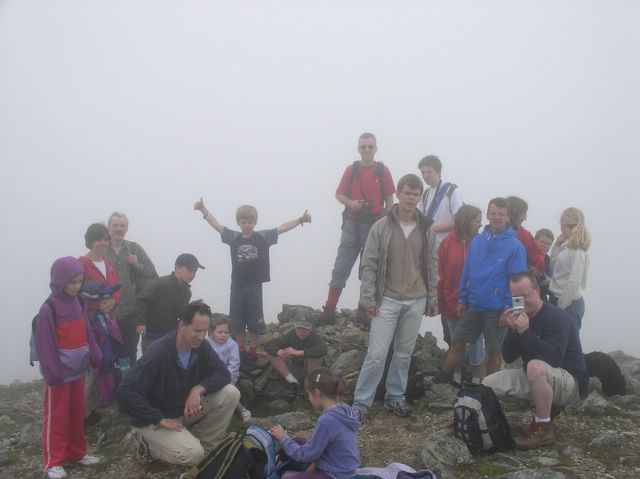
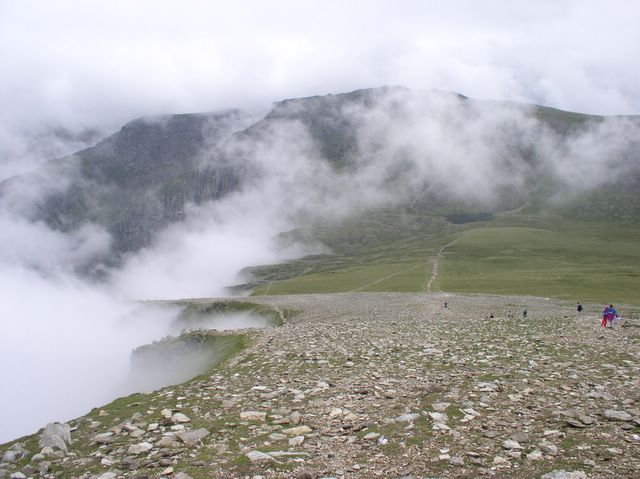
Wednesday, August 10, 2005
I'm back!
More to come about holiday activities at a later stage, but it looks as though comments by GWB have pretty much set the ID world alight whilst I have been away! Just quickly, though ....
From the Washington Post
In what sense is the assertion that there is no God - or no need for a God - which is what underlies the basis of evolution as a theory and is explicitly the motivation for many leading evolutionists - not a religious viewpoint?
From the Washington Post
Bush's comments were "irresponsible," said Barry W. Lynn, executive director of Americans United for Separation of Church and State. He said the president, by suggesting that students hear two viewpoints, "doesn't understand that one is a religious viewpoint and one is a scientific viewpoint." Lynn said Bush showed a "low level of understanding of science."
In what sense is the assertion that there is no God - or no need for a God - which is what underlies the basis of evolution as a theory and is explicitly the motivation for many leading evolutionists - not a religious viewpoint?
Saturday, July 30, 2005
Holidays
We're at the Carey Family Conference in Shropshire this week, followed by a few days with friends.
Tuesday, July 26, 2005
Poem for Summer
The theme was an original creation of my eldest, when aged about 3. The variations were just for fun, and have little artistic merit, but might raise a smile.
Variations on a theme
Theme
Two little piggy hays
in the ragy run.
One got tired
and then with one.
K.F.
Variation I
Ten little lemmings
sitting on a wall.
One jumped off
and so did all the rest.
Variation II
Five little pussy cats
who couldn't add up.
One brought a friend
and then there were eight.
Variation III
Six little hedgehogs
who couldn't take away.
One went to get some lunch
and then there were four.
Variation IV
Ten corrupt politicians
holding an election.
When the ballot was counted
then there were five hundred.
P.F.
Variations on a theme
Theme
Two little piggy hays
in the ragy run.
One got tired
and then with one.
K.F.
Variation I
Ten little lemmings
sitting on a wall.
One jumped off
and so did all the rest.
Variation II
Five little pussy cats
who couldn't add up.
One brought a friend
and then there were eight.
Variation III
Six little hedgehogs
who couldn't take away.
One went to get some lunch
and then there were four.
Variation IV
Ten corrupt politicians
holding an election.
When the ballot was counted
then there were five hundred.
P.F.
Monday, July 25, 2005
What makes somebody a universal hero?
(With apologies to David Colbert, who has a similarly titled chapter in "The Magical Worlds of Harry Potter")
I have a theory. Humans are supposed to respond to stories, because God has designed us to respond to the Great Story - the storyline of the Bible in which God reveals himself and displays his purposes to save people from out of the world. (Incidentally, I'm not sure that evolution has a terribly sound explanation as to why we should relate to narrative! :-) )
I would suggest that one of the implications of that is that there are various narrative motifs which have near-universal human significance. Sacrificial love is one; the idea of a hero is another. I have no doubt that there are learned papers that have been written that explore these themes, though possibly not making the connection with the plotline of the Bible. One of the problems of the Bible is that it is rarely regarded these days as a narrative whole. Christians focus on individual chapters. Non-christians tend to focus on the fact that the book was written over 1600 years by lots of different authors, and overlook the overarching themes. (Like the fact that it starts of with humans created in the presence of God, and ends with humans in the presence of God). Biblical theology seeks to move back towards having a regard for the whole Bible, and I have been strongly influenced by this approach for some years.
Anyway, it was interesting to read in Colbert's book above reference to the idea of a universal hero. Examples of universal heros or Hidden Monarchs - such as "Oedipus, Moses or King Arthur" - or Cinderella or the Ugly Duckling! - abound in "every culture". What are the characteristics of "The Hero with a Thousand Faces"? According to Joseph Campbell (cited in Colbert's book), their story may be summarized as follows:
@ The hero is called to adventure from everyday life.
@ The hero may refuse the call to adventure, but if he does, he will find he has no choice.
@ The hero meets a protector and guide who offers supernatural aid.
@ The hero encounters a first threshold to the new world, and enters "the belly of the whale".
@ The hero follows a road of trials.
@ The hero is abducted.
@ The hero fights a symbolic dragon. He may suffer a ritual death.
@ The hero is recognised by or reunited with his father. He comes to understand this source of control over his life.
@ The hero becomes nearly divine. He has travelled past ignorance and fear.
@ The hero receives the goal of his quest.
@ The hero takes a "magic flight" back to his original world. He crosses the return threshold.
@ The hero becomes master of two worlds.
@ The hero has won the freedom to live.
Interesting how close some of those are to the story of Jesus. Campbell (whose book on the basis of these comments I feel strongly drawn to read!) says, apparently, "every one of us shares the supreme ordeal." However, what Biblical theology would imply is that the reason the hero is significant for us is because we don't all share this ordeal - we are looking for a hero who will do this on our behalf, and who will bestow his favour on us.
I have a theory. Humans are supposed to respond to stories, because God has designed us to respond to the Great Story - the storyline of the Bible in which God reveals himself and displays his purposes to save people from out of the world. (Incidentally, I'm not sure that evolution has a terribly sound explanation as to why we should relate to narrative! :-) )
I would suggest that one of the implications of that is that there are various narrative motifs which have near-universal human significance. Sacrificial love is one; the idea of a hero is another. I have no doubt that there are learned papers that have been written that explore these themes, though possibly not making the connection with the plotline of the Bible. One of the problems of the Bible is that it is rarely regarded these days as a narrative whole. Christians focus on individual chapters. Non-christians tend to focus on the fact that the book was written over 1600 years by lots of different authors, and overlook the overarching themes. (Like the fact that it starts of with humans created in the presence of God, and ends with humans in the presence of God). Biblical theology seeks to move back towards having a regard for the whole Bible, and I have been strongly influenced by this approach for some years.
Anyway, it was interesting to read in Colbert's book above reference to the idea of a universal hero. Examples of universal heros or Hidden Monarchs - such as "Oedipus, Moses or King Arthur" - or Cinderella or the Ugly Duckling! - abound in "every culture". What are the characteristics of "The Hero with a Thousand Faces"? According to Joseph Campbell (cited in Colbert's book), their story may be summarized as follows:
A hero ventures forth from the world of common day into a region of supernatural wonder. Fabulous forces are there encountered and decisive victory is won. The hero comes back from this mysterious adventure with the power to bestow books on his fellow man.Here are some of the characteristics of these heroes:
@ The hero is called to adventure from everyday life.
@ The hero may refuse the call to adventure, but if he does, he will find he has no choice.
@ The hero meets a protector and guide who offers supernatural aid.
@ The hero encounters a first threshold to the new world, and enters "the belly of the whale".
@ The hero follows a road of trials.
@ The hero is abducted.
@ The hero fights a symbolic dragon. He may suffer a ritual death.
@ The hero is recognised by or reunited with his father. He comes to understand this source of control over his life.
@ The hero becomes nearly divine. He has travelled past ignorance and fear.
@ The hero receives the goal of his quest.
@ The hero takes a "magic flight" back to his original world. He crosses the return threshold.
@ The hero becomes master of two worlds.
@ The hero has won the freedom to live.
Interesting how close some of those are to the story of Jesus. Campbell (whose book on the basis of these comments I feel strongly drawn to read!) says, apparently, "every one of us shares the supreme ordeal." However, what Biblical theology would imply is that the reason the hero is significant for us is because we don't all share this ordeal - we are looking for a hero who will do this on our behalf, and who will bestow his favour on us.
ID - the "debate"
This is really a response to a comment in a post below, but what I wanted to say is more widely applicable to any darwinist who might end up here.
What really frustrates me about "the debate" is the attempt to suppress dissenting opinion that is being carried out in the name of objectivity and science - the wrangling over one guy's Ph.D. is only the tip of the iceberg. There is the offering to pay the Smithsonian to back out of an arrangement; blackballing and abusing journal editors who dare to publish articles that don't toe the line; (in the case of Eugenie Scott, NCSE, the demonstrated) writing of misleading and inaccurate articles; the re-presentation of already refuted arguments (in New Scientist). How is so-called academic freedom going to be defended by thousands of scientists - 95%+ of whom don't actually know the details of what's happening - emailing people in authority to get them to exert pressure on one or two scientists? What affect will that have on them? And will this pressure make it more or less likely that the truth will become apparent? What would happen to you if you found yourself the target of this sort of witchhunt? Would it improve the standard of your work?
Take a look at what's going on. I know it's really hard, but try and detach yourself from where you are arguing from, and look at what's happening from a neutral standpoint. Look at the rhetoric on both sides. Look at what people who hadn't even seen it were saying about "Privileged Planet" - can't you see that this is the exact opposite of the freedom which you claim to love? If you think the attitude of people who suppress the truth is undesirable, then why are you trying to become like one of them?
What really frustrates me about "the debate" is the attempt to suppress dissenting opinion that is being carried out in the name of objectivity and science - the wrangling over one guy's Ph.D. is only the tip of the iceberg. There is the offering to pay the Smithsonian to back out of an arrangement; blackballing and abusing journal editors who dare to publish articles that don't toe the line; (in the case of Eugenie Scott, NCSE, the demonstrated) writing of misleading and inaccurate articles; the re-presentation of already refuted arguments (in New Scientist). How is so-called academic freedom going to be defended by thousands of scientists - 95%+ of whom don't actually know the details of what's happening - emailing people in authority to get them to exert pressure on one or two scientists? What affect will that have on them? And will this pressure make it more or less likely that the truth will become apparent? What would happen to you if you found yourself the target of this sort of witchhunt? Would it improve the standard of your work?
Take a look at what's going on. I know it's really hard, but try and detach yourself from where you are arguing from, and look at what's happening from a neutral standpoint. Look at the rhetoric on both sides. Look at what people who hadn't even seen it were saying about "Privileged Planet" - can't you see that this is the exact opposite of the freedom which you claim to love? If you think the attitude of people who suppress the truth is undesirable, then why are you trying to become like one of them?
Saturday, July 23, 2005
Universal probability bounds
In Specification: The Pattern that Signifies Intelligence, William Dembski revisits the idea of a "universal probability bound" (see also "The Design Inference"). This is a useful concept - as a bound, it is "impervious [to] any probabilistic resources that might be brought to bear against it." If the probability of a specified event is smaller than this, then it basically won't happen by chance.
The word "specified" is important. Consider the probability bound of 10-150 that Dembski suggests. A computer could generate a random sequence of 100 letters, spaces, commas and full stops. Each 100 character sequence has a probability of one in 10-150 of arising. However, the program has to produce something - an improbable event in itself isn't significant. But suppose I wrote down a particular series of 100 letters, spaces, commas and full stops (with no knowledge of the algorithm that was used by the program). What is the likelihood of the program generating this sequence that I have specified? It is (roughly) 1 in 10150 - and with this universal probability bound, I am able to assert that this is unlikely to arise by chance in the life of the universe - and by extension, in however long the program runs for. So if the program generates this specified sequence, then somebody has cheated somewhere. Or, in Dembski's terms, we can draw an inference of design.
This figure of 10-150 is based on "the number of state changes in elementary particles throughout the history of the universe." It is reasonable to regard this as a "worst possible case" - the universe has a maximum total number of 10150 goes at anything that can be possibly conceived of - so if the probability of a specified event happening by chance is less than the reciprocal of this, we would conclude that it didn't happen by chance.
If this figure is the universal probability bound, I'd like to propose the introduction of slightly different but related probability bounds - perhaps we could call them biochemical, biological, thermodynamic and chemical probability bounds. Considering biological systems, for example, the total number of state changes in the universe is not really relevant. Fast biochemical reactions are fast, no doubt, but whereas the Planck time used to derive this universal probability bound is 10-45 seconds, the fastest biochemical reactions require a period of time at least some 30 orders of magnitude greater (the initial stages of photosynthesis reactions take a period of time of the order of 10-12 seconds. We might allow that most of the history of the universe is relevant for consideration of biochemical processes - but since the majority of the matter of the universe is hydrogen and helium (all but one thousandth of 1 percent), given that biochemical reactions basically involve mass of the universe that isn't dominated by hydrogen and helium, it would also seem to be sensible to reduce the biological probability bound by five further orders of magnitude from the cosmic probability bound. Thus an estimate for the biochemical probability bound would be 10-115.
It seems odd to be fiddling around with orders of magnitude when we are discussing such small numbers. However, probability bounds have relevance to consideration of real scientific processes, so it helps for such discussions to be based on realistic estimates. I intend to explore the implications of the biochemical probability bound in a subsequent post.
The word "specified" is important. Consider the probability bound of 10-150 that Dembski suggests. A computer could generate a random sequence of 100 letters, spaces, commas and full stops. Each 100 character sequence has a probability of one in 10-150 of arising. However, the program has to produce something - an improbable event in itself isn't significant. But suppose I wrote down a particular series of 100 letters, spaces, commas and full stops (with no knowledge of the algorithm that was used by the program). What is the likelihood of the program generating this sequence that I have specified? It is (roughly) 1 in 10150 - and with this universal probability bound, I am able to assert that this is unlikely to arise by chance in the life of the universe - and by extension, in however long the program runs for. So if the program generates this specified sequence, then somebody has cheated somewhere. Or, in Dembski's terms, we can draw an inference of design.
This figure of 10-150 is based on "the number of state changes in elementary particles throughout the history of the universe." It is reasonable to regard this as a "worst possible case" - the universe has a maximum total number of 10150 goes at anything that can be possibly conceived of - so if the probability of a specified event happening by chance is less than the reciprocal of this, we would conclude that it didn't happen by chance.
If this figure is the universal probability bound, I'd like to propose the introduction of slightly different but related probability bounds - perhaps we could call them biochemical, biological, thermodynamic and chemical probability bounds. Considering biological systems, for example, the total number of state changes in the universe is not really relevant. Fast biochemical reactions are fast, no doubt, but whereas the Planck time used to derive this universal probability bound is 10-45 seconds, the fastest biochemical reactions require a period of time at least some 30 orders of magnitude greater (the initial stages of photosynthesis reactions take a period of time of the order of 10-12 seconds. We might allow that most of the history of the universe is relevant for consideration of biochemical processes - but since the majority of the matter of the universe is hydrogen and helium (all but one thousandth of 1 percent), given that biochemical reactions basically involve mass of the universe that isn't dominated by hydrogen and helium, it would also seem to be sensible to reduce the biological probability bound by five further orders of magnitude from the cosmic probability bound. Thus an estimate for the biochemical probability bound would be 10-115.
It seems odd to be fiddling around with orders of magnitude when we are discussing such small numbers. However, probability bounds have relevance to consideration of real scientific processes, so it helps for such discussions to be based on realistic estimates. I intend to explore the implications of the biochemical probability bound in a subsequent post.
Friday, July 22, 2005
Opinions expressed are not necessarily those of ...
Some people (well, actually one person, although maybe others nearly did) have asked me about the Google adverts which appear on my page. I don't endorse any of the products or services offered, I don't expect to receive a particularly lucrative stream of revenue from having the adverts there, and I have only been interested in "clicking through" myself a handful of times.
I put them there for several reasons - for the technical practice of fiddling around with the Blogger template to make it work; out of interest to see how intelligently AdSense (the advertising scheme) "understood" the text in my posts; to have something on my page that would be a little more original; and to provide more links that might improve my visibility in search engines (the ratings game ... I want to know if "Exile from GROGGS" can take over the world - buwah hah hah hah haaaaa!).
No reasons of any great significance, really, any more than this blog has any real significance. But rather more honestly than many advertising media, and at risk of biting the hand that feeds (not that it's really fed at all...), I would just like to say, "Caveat Emptor". Or "Caveat spector". Or whatever ....
I put them there for several reasons - for the technical practice of fiddling around with the Blogger template to make it work; out of interest to see how intelligently AdSense (the advertising scheme) "understood" the text in my posts; to have something on my page that would be a little more original; and to provide more links that might improve my visibility in search engines (the ratings game ... I want to know if "Exile from GROGGS" can take over the world - buwah hah hah hah haaaaa!).
No reasons of any great significance, really, any more than this blog has any real significance. But rather more honestly than many advertising media, and at risk of biting the hand that feeds (not that it's really fed at all...), I would just like to say, "Caveat Emptor". Or "Caveat spector". Or whatever ....
Thursday, July 21, 2005
Harry Potter and the Anticipated Storyline
I was one of the 68 trillion people who got "Half Blood Prince" on the day it came out - though I did at least wait until the afternoon before picking up my pre-ordered copy, and not go to the shops at midnight specially. This may have been partly due to the fact that I had to get up at 4.30 for work (yes, I do work sometimes: yes, in the morning: no, I know that's "not a time" for most people).
It took me several years before I read the first one, and then the pace has quickened through the other five. The initial hesitation was partly due to the furore amongst Christians - I am still conscious of the fact that some Christians would not be happy with their children reading it. This is certainly an opinion they are free to hold, though in defence of the Harry Potter stories, J.K.Rowling's world is apparently a great deal more "Christian" than that of Philip Pullman, in the "His Dark Materials" series,
I had mentally sketched out where I thought the narrative would be going in book 6 and onwards. One of the themes that I had assumed would become more important would be the songs of the Sorting Hat - which has, in a semi-prophetic way, been saying for the last few books that the houses in Hogwarts need to pull together to overcome evil. I assumed that this would lead at some stage to Harry and Snape somehow coming to terms with their past, so that Slytherin could work with the other houses to overcome Voldemort. Suffice it to say that it now looks like this isn't going to happen....
Also, given that Harry's power over Voldemort is the fact that he is able to love, his motivation is drifting rather strongly towards hatred - understandable, but a conundrum that has to be overcome, I suspect. I'm reminded of Luke Skywalker being challenged by the emperor to fight him with hatred in "Return of the Jedi".
Incidentally, for anybody else who ends up here who has read the book, is it only me who thinks that Rowling has left herself an awful lot of loose ends to tie up in what she has said will be the last book of the series?
It took me several years before I read the first one, and then the pace has quickened through the other five. The initial hesitation was partly due to the furore amongst Christians - I am still conscious of the fact that some Christians would not be happy with their children reading it. This is certainly an opinion they are free to hold, though in defence of the Harry Potter stories, J.K.Rowling's world is apparently a great deal more "Christian" than that of Philip Pullman, in the "His Dark Materials" series,
I had mentally sketched out where I thought the narrative would be going in book 6 and onwards. One of the themes that I had assumed would become more important would be the songs of the Sorting Hat - which has, in a semi-prophetic way, been saying for the last few books that the houses in Hogwarts need to pull together to overcome evil. I assumed that this would lead at some stage to Harry and Snape somehow coming to terms with their past, so that Slytherin could work with the other houses to overcome Voldemort. Suffice it to say that it now looks like this isn't going to happen....
Also, given that Harry's power over Voldemort is the fact that he is able to love, his motivation is drifting rather strongly towards hatred - understandable, but a conundrum that has to be overcome, I suspect. I'm reminded of Luke Skywalker being challenged by the emperor to fight him with hatred in "Return of the Jedi".
Incidentally, for anybody else who ends up here who has read the book, is it only me who thinks that Rowling has left herself an awful lot of loose ends to tie up in what she has said will be the last book of the series?
Monday, July 18, 2005
Academic freedom?
How much might it cost to express opposition to darwinism in a university? Follow this link for more information.
Saturday, July 16, 2005
New Scientist reaction 4
One of the consistent objections to Intelligent Design is that its proponents are often Christians, or theists, and that this constitutes an argument against ID - I'm not sure it was specifically included in the list below, although the "Monty Python Proof" comes close. Hence, the New Scientist article (Holmes and Randerson) highlighted the following phrase:
In Lawrence Krauss's addition to the article, "Survival of the Slickest", he says:
In the editorial, New Scientist points out that
This approach is shared by Scientific American - in their article "The Woodstock of Evolution", by Michael Shermer, published Jun 27,2005, he writes:
A couple of comments.
1) Isn't it likely that people are going to do research and present opinions that are consistent with their worldview? What is the likelihood of somebody who believes that the whole idea of God is ridiculous doing research that might demonstrate that there is a requirement for an external intelligent agent? Or seeking to challenge the consensus that there is no such requirement?
2) Although people's worldview will have a bearing on the sort of studies they undertake, it is not appropriate to make a judgement on the quality of their research based on their worldview. In fact, this is what is known as prejudice - prejudging something. For example, Dembski's explanatory filter stands or falls as a piece of analysis independently of whether he is a Christian. Irreducible complexity can be identified (or not) independently of whether Michael Behe goes to church. So why raise their personal beliefs at all? And yet, in almost every article analysing the ID movement, there it is! "They're all Christians!"
Let's put it another way. Supposing somebody wrote a paper in support of evolution - perhaps a response to one of the ID papers. Is it a valid argument to say: "Ah! But the person who wrote that is an atheist! That means he's bound to take that point of view - because he is trying to show that God doesn't exist"? On one level, it's trivial - that much is obvious. But on another level, the writer would have every right to be gravely offended - "What do my beliefs about God have to do with it?" This cuts both ways.
3) It is inevitable that, if ID were to prove itself to be well-founded, this would have a philosophical impact beyond science (note the darwinist criticism of the broader agenda of ID and organisations such as the Discovery Institute). But darwinists can hardly grumble at that - look at the way in which darwinism has crossed into all sorts of other disciplines - not always for the good of society. The problem is that it is the wider impact of an alternative worldview that makes it so unpalatable to the atheist world (in which I am including people whose idea of God is of something solely subjective, who is unable to have any real impact on the universe - a definition that I know would make them angry! :) ). Of course anything that might lead to the conclusion that there is a God who is there, and who acts, will rattle people's cages. But shooting (or ridiculing) the messenger won't change whether it is true or not.
Most advocates of intelligent design are professed Christians, yet avoid spelling out the kind of designer they have in mind.
In Lawrence Krauss's addition to the article, "Survival of the Slickest", he says:
[Jonathan Wells] claimed his attacks on evolution follow from his years of studying biology. But in an essay ... he says that as a follower of the Unification Church ... he was given a mission to undermine Darwinism.(as though those two things are mutually exclusive).
In the editorial, New Scientist points out that
one of the governing goals of the Discovery Institute, ID's spiritual home, is to spread the word "that nature and human beings are created by God."
This approach is shared by Scientific American - in their article "The Woodstock of Evolution", by Michael Shermer, published Jun 27,2005, he writes:
The fact is that virtually all Intelligent Design creationists are Evangelical Christians who privately believe that ID and God are one and the same.He does have the decency to add, "There is nothing wrong with that..." - thanks, pal! So freedom of religion isn't quite dead, yet.
A couple of comments.
1) Isn't it likely that people are going to do research and present opinions that are consistent with their worldview? What is the likelihood of somebody who believes that the whole idea of God is ridiculous doing research that might demonstrate that there is a requirement for an external intelligent agent? Or seeking to challenge the consensus that there is no such requirement?
2) Although people's worldview will have a bearing on the sort of studies they undertake, it is not appropriate to make a judgement on the quality of their research based on their worldview. In fact, this is what is known as prejudice - prejudging something. For example, Dembski's explanatory filter stands or falls as a piece of analysis independently of whether he is a Christian. Irreducible complexity can be identified (or not) independently of whether Michael Behe goes to church. So why raise their personal beliefs at all? And yet, in almost every article analysing the ID movement, there it is! "They're all Christians!"
Let's put it another way. Supposing somebody wrote a paper in support of evolution - perhaps a response to one of the ID papers. Is it a valid argument to say: "Ah! But the person who wrote that is an atheist! That means he's bound to take that point of view - because he is trying to show that God doesn't exist"? On one level, it's trivial - that much is obvious. But on another level, the writer would have every right to be gravely offended - "What do my beliefs about God have to do with it?" This cuts both ways.
3) It is inevitable that, if ID were to prove itself to be well-founded, this would have a philosophical impact beyond science (note the darwinist criticism of the broader agenda of ID and organisations such as the Discovery Institute). But darwinists can hardly grumble at that - look at the way in which darwinism has crossed into all sorts of other disciplines - not always for the good of society. The problem is that it is the wider impact of an alternative worldview that makes it so unpalatable to the atheist world (in which I am including people whose idea of God is of something solely subjective, who is unable to have any real impact on the universe - a definition that I know would make them angry! :) ). Of course anything that might lead to the conclusion that there is a God who is there, and who acts, will rattle people's cages. But shooting (or ridiculing) the messenger won't change whether it is true or not.
Wednesday, July 13, 2005
New Scientist reaction interchange
"ID is not anti-evolution"
If ID isn't anti-evolution, why is the best-selling book promoted by ID advocates the rabidly anti-evolution (and grotesquely in error) Icons of Evolution by rabid anti-evolutionist Jonathan Wells?
Even if there is "something in" some of the icons, they are presented in a misleading way by biology textbooks - and they imply that darwinian evolution has everything sewn up, when in fact it has yet to show that it is capable of anything really substantial (origin of life, significant morphological changes, transitions between phyla, changes in numbers of chromosomes). However, most ID proponents believe in an old earth, and different ID proponents believe that evolution could have been responsible for different aspects of organisms.
As to why the book is best-selling - well, that's because people buy it. But that doesn't signify - I suspect that "The Blind Watchmaker" sells just as well ....
Also, nobody - not even the most fundamentalist Young Earth Creationist - argues against evolution in its broadest sense - which is what is implied by saying that ID and creationism are "anti-evolution", without defining evolution, and then ridiculing them for this stance - because that would include any form of descent with modification. Everybody accepts that descent with modification happens - it's what happens when humans breed animals, for example.
But suppose one were rather to say, "ID proponents don't believe that naturalistic mechanisms explain the initial origin of life." Or, "ID proponents don't believe that descent with modification as a mechanism is powerful enough to get us from the first prokaryotic cell to homo sapiens." Worded in those terms, suddenly the position of ID proponents looks a bit less stupid. But of course, because the game being played by the evolutionist establishment is every bit as political as that they accuse the ID community of playing, there is no way that they would use precision to ensure clarity in this debate.
If ID isn't anti-evolution, why is the best-selling book promoted by ID advocates the rabidly anti-evolution (and grotesquely in error) Icons of Evolution by rabid anti-evolutionist Jonathan Wells?
Even if there is "something in" some of the icons, they are presented in a misleading way by biology textbooks - and they imply that darwinian evolution has everything sewn up, when in fact it has yet to show that it is capable of anything really substantial (origin of life, significant morphological changes, transitions between phyla, changes in numbers of chromosomes). However, most ID proponents believe in an old earth, and different ID proponents believe that evolution could have been responsible for different aspects of organisms.
As to why the book is best-selling - well, that's because people buy it. But that doesn't signify - I suspect that "The Blind Watchmaker" sells just as well ....
Also, nobody - not even the most fundamentalist Young Earth Creationist - argues against evolution in its broadest sense - which is what is implied by saying that ID and creationism are "anti-evolution", without defining evolution, and then ridiculing them for this stance - because that would include any form of descent with modification. Everybody accepts that descent with modification happens - it's what happens when humans breed animals, for example.
But suppose one were rather to say, "ID proponents don't believe that naturalistic mechanisms explain the initial origin of life." Or, "ID proponents don't believe that descent with modification as a mechanism is powerful enough to get us from the first prokaryotic cell to homo sapiens." Worded in those terms, suddenly the position of ID proponents looks a bit less stupid. But of course, because the game being played by the evolutionist establishment is every bit as political as that they accuse the ID community of playing, there is no way that they would use precision to ensure clarity in this debate.
Tuesday, July 12, 2005
New Scientist reaction 3
A couple more quick responses to the articles in "New Scientist" - which I have now bought!
ID is not creationism. Creationists don't recognise ID as creationism. ID'ers don't recognise ID as creationism. Creationism carries out science with a prior commitment to the authority of the Bible. ID doesn't. The fact that many ID proponents are Christians is actually irrelevant - firstly, some aren't; secondly, their religious beliefs have no more bearing on the validity of their conclusions than their sexuality or their height. To argue otherwise is a form of discrimination. Debating on the character of the proponents is not science. Arguing that they are pursuing a political or religious agenda may or may not be true - but again, it is irrelevant to the science of the issue.
The film at the Smithsonian, Washington D.C. was not "creationist". In fact, it wasn't about evolution at all. It is about the Copernican Principle. See the website if you want more accurate information.
ID is not anti-evolution. ID says that darwinian evolution doesn't answer all the problems. At the recent Galapagos Islands conference, reported by Michael Shermer in Scientific American, apparently as much was said by William Provine and Lynn Marguiles - but the science establishment didn't bat an eyelid. And yet ID is portrayed in New Scientist as being as stupid as somebody telling a class that it is disputable that the earth goes round the sun. Why?
ID is not creationism. Creationists don't recognise ID as creationism. ID'ers don't recognise ID as creationism. Creationism carries out science with a prior commitment to the authority of the Bible. ID doesn't. The fact that many ID proponents are Christians is actually irrelevant - firstly, some aren't; secondly, their religious beliefs have no more bearing on the validity of their conclusions than their sexuality or their height. To argue otherwise is a form of discrimination. Debating on the character of the proponents is not science. Arguing that they are pursuing a political or religious agenda may or may not be true - but again, it is irrelevant to the science of the issue.
The film at the Smithsonian, Washington D.C. was not "creationist". In fact, it wasn't about evolution at all. It is about the Copernican Principle. See the website if you want more accurate information.
ID is not anti-evolution. ID says that darwinian evolution doesn't answer all the problems. At the recent Galapagos Islands conference, reported by Michael Shermer in Scientific American, apparently as much was said by William Provine and Lynn Marguiles - but the science establishment didn't bat an eyelid. And yet ID is portrayed in New Scientist as being as stupid as somebody telling a class that it is disputable that the earth goes round the sun. Why?
Early World Music
Live8 was criticised in some quarters for having insufficient regard to African artists, particularly given the focus of the concert on African poverty. This criticism showed recognition of the fact that the sounds and variety of popular music are far more diverse now than they have been in previous decades - popular music is no longer the sole preserve of Western Europe and North America. Hats off particularly to Andy Kershaw, and the BBC who have given him a platform, for bringing much world music to the attention of British hearers.
It could be argued that Paul Simon ("Graceland", "Rhythm of the Saints") and David Byrne ("Rei Momo") were influential in first bringing African and South American music into the mainstream. However, in the early 70's, a serious attempt was made to bring African music, rhythms and themes to the mainstream - by somebody who would probably be regarded by many people as the antithesis of progress in music - Neil Diamond.
Of "Tap Root Manuscript", Neil Diamond wrote:
On one side (pre CD era, of course!) was a series of conventional tracks, including the single "Cracklin' Rosie" and a cover of "He ain't heavy, he's my brother." On the other side were a set of songs that used African rhythms, African voices, and African themes. See also the reviews on Amazon.com. This is a stunning and significant piece of work: it never fulfilled the potential it had to revolutionise popular music in the West, but it is remarkable nonetheless.
It could be argued that Paul Simon ("Graceland", "Rhythm of the Saints") and David Byrne ("Rei Momo") were influential in first bringing African and South American music into the mainstream. However, in the early 70's, a serious attempt was made to bring African music, rhythms and themes to the mainstream - by somebody who would probably be regarded by many people as the antithesis of progress in music - Neil Diamond.
Of "Tap Root Manuscript", Neil Diamond wrote:
When rhythm and blues lost its sensuality for me I fell in love with a woman named gospel. We met secretly in the churches of Harlem, and made love at revival meetings in Mississippi. And loving her as I did, I found a great yearning to know of her roots. And I found them. And they were in Africa. And they left me breathless. The African Trilogy is an attempt to convey my passion for the folk music of that black continent.
On one side (pre CD era, of course!) was a series of conventional tracks, including the single "Cracklin' Rosie" and a cover of "He ain't heavy, he's my brother." On the other side were a set of songs that used African rhythms, African voices, and African themes. See also the reviews on Amazon.com. This is a stunning and significant piece of work: it never fulfilled the potential it had to revolutionise popular music in the West, but it is remarkable nonetheless.
Monday, July 11, 2005
New Scientist reaction 2
ID's appeal to supernatural forces by definition puts it outside the scope of science, says Eugenie Scott head of the NCSE. After all, saying "God did it" can never be disproved.
This was highlighted in the text - the editors presumably regarded this as a key point. However, it is misleading. ID isn't appealing to "supernatural forces". It is appealing to intelligent agency. It is saying that various characteristics of creatures and the universe cannot be explained by naturalistic mechanisms. The same analysis occurs when archaeological artefacts are discovered; the same process is occurring at the moment as the SETI programme analyses radio signals from outer space; the same process occurs when a pathologist looks at a corpse and has to come to a conclusion as to the likely cause of death.
What ID - more specifically, Dembski's Explanatory Filter and the mathematics surrounding it - have done is seek to provide a mathematical basis for this previously intuitive assessment. And what happens when this Explanatory Filter is applied to the information in creatures is that it suggests that they require agency.
The argument against ID should not be on the level of objecting to the conclusion - that an intelligent agent is required. It should be on the level of the presuppositions - either the Explanatory Filter is wrong, or the assessment of the amount of complex, specified information in organisms is wrong.
Secondly, as was pointed out in "By Design or by Chance?" by Denyse O'Leary (as well as elsewhere), requiring the presence of a god doesn't place a line of enquiry outside the scope of science. It places it outside the scope of philosophical materialism. It is incorrect to identify philosophical materialism as science. Maxwell, Newton, Galileo, Copernicus, Kepler, and many other people who have shaped science would strongly disagree with this sentence.
Finally - theological point - there is a false dichotomy here. Materialistic science here is still playing the "God of the Gaps" game - if we can just show that God isn't required, then we can show that belief in God isn't required, and we can do away with the whole God thing once and for all.
Of course, it isn't worded like that. The article talks about the politics of the ID movement. However, the anti-ID movement is playing political games as well - by seeking to relegate all religious belief to an entirely private sphere, and exclude it from public discourse. See "Rocks of Ages" by Stephen Jay Gould for his perspective on this - I suppose that we should at least be thankful that, unlike Richard Dawkins, he wasn't pushing to have people with religious beliefs locked up.
However, from a theological perspective, it is incorrect to argue that God is only involved if we can't come up with a naturalistic explanation of a phenomenon. From a theological perspective, the universe behaves in an orderly manner because God is orderly. The sun rises because God commands it to - although the mechanism that allows the sun to rise is the rotation of the earth. Yes, I know that there is the problem of evil - but there are answers for that, it isn't insurmountable. On the other hand, to the best of my knowledge, the only answer to the problem of tractability is the rather lame anthropic one - "well, it has to be like that, or we wouldn't be able to observe it." Another key ID book - "The Privileged Planet" - addresses this and other cosmological issues. Again, the authors of the New Scientist article made no reference to it.
New Scientist reaction 1
From "A sceptic's guide to intelligent design", New Scientist 9/7/05(Bob Holmes and James Randerson)
Firstly, let's note that the odds of a particular sequence of amino acids arising varies geometrically with the length of the sequence. So if 10 amino acids need to be specified, the improbability is 1 in 20^10 - that is, 1 in 10^13. If 100 amino acids need to be specified, the improbability is 1 in 20^100 - that is, 1 in 10^130. For the sake of argument, let's assume that this represents one typical protein. This number - 1 in 10^130 - is pretty much at the limit of the "probabilistic resources" of the universe - in other words, in the entire history of the universe, if all matter were dedicated to randomly producing amino acid sequences all the time, you might stand a reasonable chance of coming up with one fully specified 100 aa residue protein.
That much isn't contested. What is disputed by ID opponents is that this 100 amino acid protein needs to be fully specified. The improbability is irrelevant, opponents of ID argue, because a less specified protein would still be functional, and natural selection provides a basis for improving its functionality. "Therefore evolution is true." (see below)
However, how specified does a sequence of amino acids need to be to provide some functionality? The authors mention that proteins in different species might vary by 80 to 90 per cent and yet still perform the same function. Let's say that our 100 aa residue protein only needs to be 15% specified: this represents an improbability of 1 in 10^19. Where do first attempts at searching for new functionality come from? And do cells really have the energy resources and the informational resources to experiment with new amino acid sequences to search for particular functionality? These questions are fundamental to the debate about whether random mutation and natural selection might work as a basis for evolution.
Most papers which talk about the appearance of new functionality in organisms show the co-option of already present complex proteins. But the question isn't addressed as to where these predecessors might have arisen from. You can't keep on moving the problem back - at some stage, proteins with specific functionality have to appear from somewhere (even if the level of specification only amounts to improbabilities of between 1 in 10^20 and 1 in 10^50).
Is 10 to 20 per cent a typical level of specification for proteins to start to express functionality? Or is this the most generous estimate? The similarity in Cytochrome C (conveniently, a protein that is around 100 aa residues in length) between humans and yeast, discussed in an article here,
is 64%. If cytochrome C has to be 36% specified to have the required functionality, this still represents an improbability of 1 in 10^46. Obviously, this is a lot less improbable than 1 in 10^130 - but if the entire mass of the earth were randomly generated proteins of typically 1000 proton molecular weight, only 1 in 10 would correspond to this reduced specification of cytochrome c.
(I think!)
If it doesn't need to be 36% specified to have the required functionality, then how specified does it need to be? Convincing answers to questions like this would do a great deal to bolster the credibility of darwinian challenges to ID - but they don't arise.
This argument against ID is not sound. It is a vague hand-waving argument, which when examined closely fails to offer any detail or insight into how evolution might solve probabilistic problems.
But these calculations [of how improbable it is that proteins could arise by chance] are logically flawed because they focus on a single, specified outcome, says Kenneth Miller ... It is like equating the odds of drawing a particular two-pair hand - say a pair of red queens, a pair of black 10s and the ace of clubs. "By demanding a particular outcome, as opposed to a functional outcome, you stack the odds," Miller says. What these calculations fail to recognise is that many different protein sequences can be functional. It is not uncommon for proteins in different species to vary by 80 to 90 per cent, yet still perform the same function.
Firstly, let's note that the odds of a particular sequence of amino acids arising varies geometrically with the length of the sequence. So if 10 amino acids need to be specified, the improbability is 1 in 20^10 - that is, 1 in 10^13. If 100 amino acids need to be specified, the improbability is 1 in 20^100 - that is, 1 in 10^130. For the sake of argument, let's assume that this represents one typical protein. This number - 1 in 10^130 - is pretty much at the limit of the "probabilistic resources" of the universe - in other words, in the entire history of the universe, if all matter were dedicated to randomly producing amino acid sequences all the time, you might stand a reasonable chance of coming up with one fully specified 100 aa residue protein.
That much isn't contested. What is disputed by ID opponents is that this 100 amino acid protein needs to be fully specified. The improbability is irrelevant, opponents of ID argue, because a less specified protein would still be functional, and natural selection provides a basis for improving its functionality. "Therefore evolution is true." (see below)
However, how specified does a sequence of amino acids need to be to provide some functionality? The authors mention that proteins in different species might vary by 80 to 90 per cent and yet still perform the same function. Let's say that our 100 aa residue protein only needs to be 15% specified: this represents an improbability of 1 in 10^19. Where do first attempts at searching for new functionality come from? And do cells really have the energy resources and the informational resources to experiment with new amino acid sequences to search for particular functionality? These questions are fundamental to the debate about whether random mutation and natural selection might work as a basis for evolution.
Most papers which talk about the appearance of new functionality in organisms show the co-option of already present complex proteins. But the question isn't addressed as to where these predecessors might have arisen from. You can't keep on moving the problem back - at some stage, proteins with specific functionality have to appear from somewhere (even if the level of specification only amounts to improbabilities of between 1 in 10^20 and 1 in 10^50).
Is 10 to 20 per cent a typical level of specification for proteins to start to express functionality? Or is this the most generous estimate? The similarity in Cytochrome C (conveniently, a protein that is around 100 aa residues in length) between humans and yeast, discussed in an article here,
is 64%. If cytochrome C has to be 36% specified to have the required functionality, this still represents an improbability of 1 in 10^46. Obviously, this is a lot less improbable than 1 in 10^130 - but if the entire mass of the earth were randomly generated proteins of typically 1000 proton molecular weight, only 1 in 10 would correspond to this reduced specification of cytochrome c.
(I think!)
If it doesn't need to be 36% specified to have the required functionality, then how specified does it need to be? Convincing answers to questions like this would do a great deal to bolster the credibility of darwinian challenges to ID - but they don't arise.
This argument against ID is not sound. It is a vague hand-waving argument, which when examined closely fails to offer any detail or insight into how evolution might solve probabilistic problems.
New Scientist - poor article on Intelligent Design
I have read New Scientist on-off since I was doing O-levels, so was interested to see what they would write about Intelligent Design. However, having read the article (there is a link to it on William Dembski's blogsite listed below), I have to say that I thought it was poor - at best the journalists uncritically presented out of date argumentation from opponents; at worst the writers and editors have used their position to deliberately misrepresent and undermine ID.
I would strongly encourage any New Scientist readers who read the article and who come here for comment to at least read William Dembski's comments. If I get the chance, I'll highlight some of the weaker points in future posts.
PS See above.
I would strongly encourage any New Scientist readers who read the article and who come here for comment to at least read William Dembski's comments. If I get the chance, I'll highlight some of the weaker points in future posts.
PS See above.
Friday, July 08, 2005
Terrorism in UK
The consensus is that it was only a matter of time before the UK was hit by the sort of terrorism that has hit other countries. There is also a pretty widespread acceptance that, dreadful as yesterday's events were, particularly for those people caught up in it or affected by it, then if that is all the UK faces, we will have got away lightly.
One of the odd things that I noticed in people talking about the events of yesterday, and the people who might have been directly affected, was how many people had "lucky escapes" - a woman who chose to go into a different carriage because the one she first went to was too full - somebody who chose to work from home that morning, and so was away from the affected area - and so on.
There are two possible conclusions - the relative weight you give to one over the other will depend a lot on your worldview. The first is to attribute these "lucky" escapes to providence - effectively saying that God overruled to keep me clear of these incidents. A corollary of this is that you are then compelled to conclude that God also overruled to determine those people who were caught up in it - who probably made a series of just as arbitrary decisions, which led to them being in "the wrong place at the wrong time". Whilst those people who had narrow escapes can be thankful, is it right for those people who happened to be affected to be resentful?
Theologically, this perspective is correct if you believe in a sovereign God. However, in coming to this conclusion as to how God acts, it is important to bear in mind what Jesus said about both natural disasters and human tragedies - it isn't possible to know what God's purposes are in allowing these things to happen, but we all need to be aware of the fact that death walks close to us all the time - and furthermore, that death isn't the worst thing that can happen to you.
The alternative is to say that everybody's lives are really a whole series of co-incidences anyway. What decides which carriage of a train I will go in? What determines which train I catch, when there is one every five minutes? What determines whether I will only go into work this afternoon? Well, it's all arbitrary and certainly hardly predictable. Some people had a lucky escape; other people were unlucky to be affected. It's just one of those things.
In some ways, since in most circumstances we can't have any idea what God's ultimate purposes are in what happens, even for Christians this may be a safer perspective. After Hitler survived an assassination attempt, he concluded that it was his destiny to survive - and he pursued his programmes of genocide all the more vigorously. It's probably safer for all of us to accept we can't know what God's purposes are than to try and work out exactly what God may have had in mind when he allowed something to happen.
One of the odd things that I noticed in people talking about the events of yesterday, and the people who might have been directly affected, was how many people had "lucky escapes" - a woman who chose to go into a different carriage because the one she first went to was too full - somebody who chose to work from home that morning, and so was away from the affected area - and so on.
There are two possible conclusions - the relative weight you give to one over the other will depend a lot on your worldview. The first is to attribute these "lucky" escapes to providence - effectively saying that God overruled to keep me clear of these incidents. A corollary of this is that you are then compelled to conclude that God also overruled to determine those people who were caught up in it - who probably made a series of just as arbitrary decisions, which led to them being in "the wrong place at the wrong time". Whilst those people who had narrow escapes can be thankful, is it right for those people who happened to be affected to be resentful?
Theologically, this perspective is correct if you believe in a sovereign God. However, in coming to this conclusion as to how God acts, it is important to bear in mind what Jesus said about both natural disasters and human tragedies - it isn't possible to know what God's purposes are in allowing these things to happen, but we all need to be aware of the fact that death walks close to us all the time - and furthermore, that death isn't the worst thing that can happen to you.
The alternative is to say that everybody's lives are really a whole series of co-incidences anyway. What decides which carriage of a train I will go in? What determines which train I catch, when there is one every five minutes? What determines whether I will only go into work this afternoon? Well, it's all arbitrary and certainly hardly predictable. Some people had a lucky escape; other people were unlucky to be affected. It's just one of those things.
In some ways, since in most circumstances we can't have any idea what God's ultimate purposes are in what happens, even for Christians this may be a safer perspective. After Hitler survived an assassination attempt, he concluded that it was his destiny to survive - and he pursued his programmes of genocide all the more vigorously. It's probably safer for all of us to accept we can't know what God's purposes are than to try and work out exactly what God may have had in mind when he allowed something to happen.
Tuesday, July 05, 2005
ID and research
A pretty consistent charge levelled against ID is that it isn't producing research, and it isn't publishing papers. Here's a couple of quotes from ARN
... and one in response to an earlier post from me ...
So why aren't papers being published? I think one only has to look at the furore that accompanied the publication of "The Origin of Biological Information and the Higher Taxonomic Categories" by Stephen C. Meyer to know the answer to this. For those who don't know, the outgoing editor was accused of all sorts of misbehaviour by (amongst others) the National Center for Science Education and its co-belligerent, Panda's Thumb. The accusations were unfounded, but in most walks of life would be considered to be intimidation.
In most settings, a paper won't even get that far. A large proportion of the science community is still strongly committed to the idea that external agency lies outside the realm of science - despite the fact that the detection of external agency (which is what ID is all about) is precisely the nature of SETI, forensics and archaeology. So (in accordance with one of the arguments against ID given below!) ID isn't science. Therefore it won't be published.
Even if somebody with a position of influence is prepared to look at a paper which advocates Intelligent Design, the treatment meted out to people and organisations that are prepared to present this material would seriously discourage them. Again, I would point out that in any other walk of life, this behaviour would be called intimidation.
On the basis of what happened within creationism, of course, this won't make "the problem" for anti-ID'ers go away. What will happen, if what happened with creationism is anything to go by, is that an ID "counter culture" will be established. This would actually be a shame, in my opinion - ID has the potential of re-unifying strands of knowledge that became separate in the enlightenment.
As was remarked in Denyse O'Leary's book, it would have been unfortunate if the editors who reviewed Einstein's original papers on relativity had been bothered by the unorthodoxy of his background or ideas - but although relativity overturned the world of physics, they had nothing to prove.
However, despite the opposition, the body of ID-related literature is growing. See this list, on the Discovery Institute website.
Why isn't research happening? This kind of follows on. Obviously many scientists in universities will have a prior commitment against ID. But which head of department would be prepared to admit that staff were being funded to carry out research in an area related to ID? What would be the impact on that department when the first paper appeared? "Professor Steve Stevenson - he's the one who funded Dr Steph Stefano who tried to get the paper published demonstrating that the genetic code could not have arisen by any naturalistic process." "Oh yeah! Well, can't say much for what goes on in his labs, then, because anybody who argues that isn't being scientific." "Won't look at any papers from there in future." "Won't encourage students to go there in future." "Must have a word with the trustees and let them know that they are risking funding to the department." etc.
We await with anticipation the IDist research proposal to study how intelligent causation brings about convergent evolution.
Go to it. We've been waiting and waiting and waiting for some details from the "intelligent design" community.
... and one in response to an earlier post from me ...
What evidence is there from intelligent design? Even the few ID-favorable articles that have slipped into science journals admit they are reviews of arguments, not new data.
So why aren't papers being published? I think one only has to look at the furore that accompanied the publication of "The Origin of Biological Information and the Higher Taxonomic Categories" by Stephen C. Meyer to know the answer to this. For those who don't know, the outgoing editor was accused of all sorts of misbehaviour by (amongst others) the National Center for Science Education and its co-belligerent, Panda's Thumb. The accusations were unfounded, but in most walks of life would be considered to be intimidation.
In most settings, a paper won't even get that far. A large proportion of the science community is still strongly committed to the idea that external agency lies outside the realm of science - despite the fact that the detection of external agency (which is what ID is all about) is precisely the nature of SETI, forensics and archaeology. So (in accordance with one of the arguments against ID given below!) ID isn't science. Therefore it won't be published.
Even if somebody with a position of influence is prepared to look at a paper which advocates Intelligent Design, the treatment meted out to people and organisations that are prepared to present this material would seriously discourage them. Again, I would point out that in any other walk of life, this behaviour would be called intimidation.
On the basis of what happened within creationism, of course, this won't make "the problem" for anti-ID'ers go away. What will happen, if what happened with creationism is anything to go by, is that an ID "counter culture" will be established. This would actually be a shame, in my opinion - ID has the potential of re-unifying strands of knowledge that became separate in the enlightenment.
As was remarked in Denyse O'Leary's book, it would have been unfortunate if the editors who reviewed Einstein's original papers on relativity had been bothered by the unorthodoxy of his background or ideas - but although relativity overturned the world of physics, they had nothing to prove.
However, despite the opposition, the body of ID-related literature is growing. See this list, on the Discovery Institute website.
Why isn't research happening? This kind of follows on. Obviously many scientists in universities will have a prior commitment against ID. But which head of department would be prepared to admit that staff were being funded to carry out research in an area related to ID? What would be the impact on that department when the first paper appeared? "Professor Steve Stevenson - he's the one who funded Dr Steph Stefano who tried to get the paper published demonstrating that the genetic code could not have arisen by any naturalistic process." "Oh yeah! Well, can't say much for what goes on in his labs, then, because anybody who argues that isn't being scientific." "Won't look at any papers from there in future." "Won't encourage students to go there in future." "Must have a word with the trustees and let them know that they are risking funding to the department." etc.
G8 summit
There is much that could be said about trade justice, reduction of carbon dioxide levels, elimination of debt, globalisation and so forth. However, time is short, and much has been said already.
However, in honour of the summit, let me give a link to a new website that an old friend of mine is involved in putting together. Remember that global problems are only the expression of the behaviour of billions of individuals.
However, in honour of the summit, let me give a link to a new website that an old friend of mine is involved in putting together. Remember that global problems are only the expression of the behaviour of billions of individuals.
Monday, July 04, 2005
After the storm

The bright greens of spring give way to the more intense, richer greens of summer. The greys and browns of winter are already appearing within the summer hues.
After a July storm, the sky is washed clean, and brilliant diamonds drop from the trees, catching the sunlight.

Under the anvil

The power and scale of a cumulonimbus cloud are phenomenal. The entire population of the world would fit into a cube a mile on a side (though you'd have to get your own lunch) - which could be dropped into the Grand Canyon, or alternatively disappear into even a small thunder cloud.
This storm is largely spent, the anvil marking its presence, looking deceptively soft ....
Sunday, July 03, 2005
Dimensions of speed
I was talking to one of my children about units of speed. We'd covered miles per hour, kilometres per hour, and proportions of the speed of sound. Then I said, "How about some more units - you need a unit of length and a unit of time."
She suggested centimetres per hour, so I asked what might move at centimetres per hour, and she suggested a snail.
"OK, another unit of speed, then."
"Millimetres per hour."
"And what might move at that sort of speed?"
"A snail with a broken leg?"
She suggested centimetres per hour, so I asked what might move at centimetres per hour, and she suggested a snail.
"OK, another unit of speed, then."
"Millimetres per hour."
"And what might move at that sort of speed?"
"A snail with a broken leg?"
Friday, July 01, 2005
The dangers of children using computers
My youngest daughter (4 years old) has developed a habit of "doing her writing" at the computer. This involved opening a document in Open Office, and typing random letters into it. From time to time, she hits the "paste" key by mistake, and something gets stuck into the text that was left there by the last user. Occasionally, she types a list of the names she can remember (pretty well! Good old Foundation Stage), or her older sister helps her embed a series of names. Occasionally we see the keys have been pressed in sequence. But for the most part, it is just random letter sequences. "To be or not to be" hasn't appeared yet.
I thought this was a mostly harmless activity. However, I am typing something at the moment, and when I tried to type "point", the auto-complete kicked in after three letters to suggest: "poiiuyrewefoplmkjklpoiyyujpoloiuytrewqaasdfdfgvvlpoie- rfgvbhhynmjuiklopaqzzzlkjhcfrt7iop".
I think I ought to go and tidy up my auto-complete dictionary ....
I thought this was a mostly harmless activity. However, I am typing something at the moment, and when I tried to type "point", the auto-complete kicked in after three letters to suggest: "poiiuyrewefoplmkjklpoiyyujpoloiuytrewqaasdfdfgvvlpoie- rfgvbhhynmjuiklopaqzzzlkjhcfrt7iop".
I think I ought to go and tidy up my auto-complete dictionary ....
Subscribe to:
Posts (Atom)